
Muskegon 72-Hour Release Access
No official Muskegon County page is labeled as a rolling 72-hour release feed. The Sheriff’s Services page links to a dynamic current-inmate portal instead. That portal can expose a Release Date control, which makes a multi-date search possible, but it is not a fixed three-day archive. A request made at a given hour covers a precise span, while the portal’s control is based on calendar dates.
A 72-hour span may touch four dates. Search each touched date, then use the exact release time from Sheriff Records to decide whether a transaction belongs inside the true window. This method is most useful after a weekend, when a one-day check could omit earlier events. It also avoids treating the inmate portal’s 24/7 availability as a promise about recent-release data.
Search Muskegon Three-Day Releases
Define the window before opening the Muskegon County inmate portal. “The last three days” can mean three whole calendar days or the exact 72 hours ending now. Those are not always the same group. Use an exact start and end when ordering records, and use calendar dates only to gather candidate rows from the public interface.
- Write the exact start and end date and time for the 72-hour span.
- List every calendar date the span touches. Depending on the current hour, there may be four.
- Run the portal’s Release Date control once per date if it appears. Capture names, identifiers, agency, and any shown release details.
- Compare each result with a MI-VINE event and the D60 or C14 docket. Mark transfers separately from community exits.
- Ask Sheriff Records for the timed booking-and-release transactions within the exact span.
- Use OTIS only when the case or Sheriff record shows MDOC involvement.
The Muskegon County 24-Hour Release List method is better for today’s tight same-day check. This three-day method is designed for catch-up, especially when release processing and public display did not line up.
Muskegon 72-Hour Release Fields
Muskegon County has not published a guaranteed recent-release field set. The portal software can present the items below when county data and configuration permit. The Sheriff release transaction may contain more exact details. Read a blank as “not shown,” not as proof that no charge, photo, hold, or release occurred.
| Field | How it helps a three-day check |
|---|---|
| Name | Starts the match but needs age, DOB, or another identifier. |
| DOB or age | Separates people with similar names. |
| Arrest Date | Identifies the booking episode; it is not the exit date. |
| Held For Agency | Shows which authority may need to confirm the event. |
| In Custody On | Supports a point-in-time custody search where exposed. |
| Release Date | Builds each calendar-date portion of the 72-hour inquiry. |
| Hold reasons or charges | Provides booking context without proving the final disposition. |
| Mugshot | May aid identity; a missing or old image says nothing conclusive about release. |
For formal proof, request booking number, exact release time, release disposition, destination, releasing authority, and holds tied to the booking episode. “Transfer” means custody continued. “Bond” still needs a check for outside holds. A court order explains why release was authorized, but a Sheriff transaction better proves when county custody changed.
Muskegon Weekend Release Checks
Official sources do not publish Muskegon’s usual physical release hour, weekend workflow, holiday schedule, exit door, or family waiting location. Do not build the three-day search around assumed processing times. A Friday court action may be processed later, and an apparent Monday portal change may reflect a weekend event or delayed public data. Only the agency transaction fixes the reported time.
The three-day span is still valuable because it gives the search room. Check D60 for misdemeanors and initial felony proceedings. Felony disposition and sentence continue in C14. A bond order, dismissal, judgment, jail credit, or commitment entry can explain a custody change, but neither docket records the precise moment someone walked out. For one named person, the full Muskegon County release verification path reconciles both courts with the custody sources.
Note: If a weekend span crosses four dates, search all four and trim results only after obtaining the exact transaction time.
Request Muskegon Three-Day Records
A focused records request is the most reliable way to obtain a period list when the portal is missing, incomplete, or unclear. Submit through the Muskegon County FOIA page. Ask for release transactions from the Muskegon County Jail between two exact timestamps. Requested fields can include full name, booking number, booking and release dates and times, release disposition or destination, releasing authority, charges or holds, and any releasable booking photograph.
The County normally responds within five business days by granting, denying, partly granting, or extending the request. One extension of up to ten business days is allowed. An electronic request is treated as received on the next business day. Fees may include permitted labor, copies, and mailing; when an estimate is more than $50, the County may seek a good-faith deposit up to half. Ask for electronic records and an itemized estimate.
The County’s online FOIA page displays the official rules and forms used for this fallback.
Those request tools are the documented route to a defined list when no official rolling feed exists.
Verify Muskegon Three-Day Results
MI-VINE can add a person-specific custody event. Search Michigan by name or identifying number, narrow the match, and read the newest event and reporting agency. A release event means the participating source reported release from that custody. A transfer means the person remained in custody elsewhere. No match can result from spelling, coverage, timing, or the lack of a participating record, so it is not proof of release.
- Sheriff release transaction
- Best source for the Muskegon County booking episode’s release time and destination, subject to available fields and redactions.
- MI-VINE
- A prompt custody-event notice that should be checked against the reporting agency.
- D60 or C14 docket
- The court trail for bond, dismissal, sentence, probation, or commitment, not a live custody clock.
- OTIS
- The MDOC status source after state intake; it excludes people whose only custody was the county jail.
A broad window produces more possible matches, so identity matters more. Compare full name, age or DOB, court, agency, booking number, and approximate dates before assigning a release to a person.
Muskegon Release-Date Portal Quirks
The local portal’s Release Date control is a useful but limited feature. It creates one query per date, not a saved rolling URL. The interface can also support Race, Sex, Cell Block, Arrest Date, Held For Agency, and In Custody On fields, plus mugshot, age, and hold information when configured. Software capability does not prove that Muskegon exposes every field or keeps past rows for a set length.
Search results should preserve what was actually visible at the time of the check. Note the date, field label, and agency. Do not fill a missing disposition from guesswork. If the name drops from the live roster, test transfer paths before calling it a community release. A state sentence belongs in MDOC’s OTIS system, a federal sentence belongs in BOP’s locator, and a covered current immigration detention may belong in ICE’s locator.
Muskegon’s Separate 72-Hour Rule
Muskegon County publishes another rule that uses “72 hours,” but it has nothing to do with a release list. The Inmate Property page says ordinary property release is limited to keys within 72 hours of incarceration during published weekday windows. A person riding out to prison or another agency must authorize a designee before departure, and property left behind is held no more than 15 days after release.
The official property page captures this local rule.
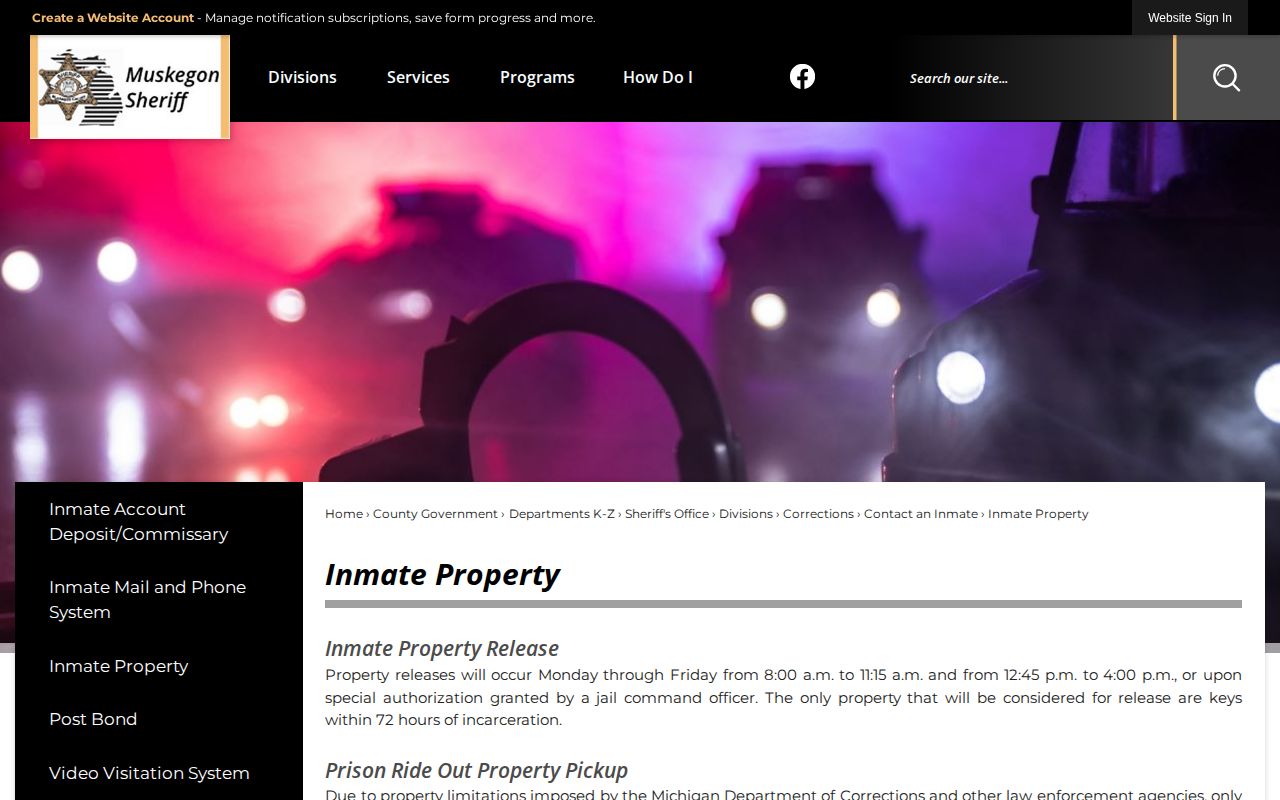
These deadlines can help a family understand property pickup after custody changes, but neither one defines who left jail during the past three days.
Keep the terms separate. A 72-hour release inquiry is a user-built custody window. The key rule measures time after incarceration, and the 15-day limit concerns property held after release or transfer. Mixing them would turn a clear local procedure into a false recent-release feed.
Complete Muskegon Release Confirmation
Finish with the source that owned the custody. For a county booking, seek the Sheriff transaction. For a state transfer, read OTIS after intake. For a court act, obtain the signed order from D60 or C14. Save a MI-VINE event as notice, then corroborate it. If Records provides a transfer destination, follow that receiving agency rather than describing the person as free.
This gives the Muskegon County 72-hour release search a sound endpoint. It covers the whole time span, accounts for portal lag, and keeps calendar-date results separate from exact release times. Most of all, it distinguishes an exit from the county jail from an exit from custody altogether.