
West Shoreline Release History
West Shoreline Correctional Facility, also identified by the code MTF, was a Level I Michigan prison in Muskegon County. It shared services with Earnest C. Brooks Correctional Facility and closed on March 24, 2018. No one can be released from West Shoreline today. A modern listing that presents it as an open prison, a current booking site, or a source of same-day releases is wrong.
A former prisoner could have left MTF through parole, discharge, or an institutional transfer while it operated. Closure-related movement to another MDOC prison was continued custody. The later receiving facility, Date Paroled, discharge date, or current status answers what happened after that move. The county jail portal is not the right source because MTF was a state prison operated by MDOC.
| Historical event | What it proves | Best record |
|---|---|---|
| Transfer from MTF | State custody continued | MDOC movement history |
| Parole from state custody | Secure custody ended; supervision began | OTIS and parole record |
| MDOC discharge | Authority ended for that sentence | OTIS or discharge certificate |
| Facility closure | The prison stopped operating | MDOC closed-facility page |
Search West Shoreline Offenders
Start with the OTIS person search. Use the MDOC number when it appears in old paperwork. Otherwise enter the name and compare date of birth, photograph when available, sentencing county, offenses, and sentence details. The current Assigned Location may be another prison or a field office. It will not be West Shoreline because the facility has been closed for years.
OTIS covers current prisoners, parolees, probationers under MDOC supervision, and people discharged within the prior three years. That last limit matters more on a historical facility page. A person discharged long ago can be absent even though MTF custody was real. Search every sentence on a matching detail record. An old discharged sentence does not erase another active sentence, and a single date should not be detached from its sentence entry.
- Copy the MDOC number from the oldest reliable document.
- Search OTIS and match several identity fields.
- Read Current Status, Assigned Location, and all sentence rows.
- Separate transfers from Date Paroled and discharge fields.
- Request MDOC history when the public coverage window has passed.
West Shoreline Date Meanings
Michigan’s public prison record uses distinct date labels. Earliest Release Date is the Parole Board jurisdiction point calculated from the judgment and relevant sentence law. It is not proof that the person left prison. Maximum Discharge Date is the potential sentence end if no other sentence or hold controls. Date Paroled identifies a parole event, while a discharge field marks the end of MDOC authority for the stated sentence.
A transfer date from West Shoreline should never be relabeled as a release date. During a closure, prisoners may move between institutions without any change in the underlying sentence. Parole can occur later from a different prison. Discharge can occur later still, after supervision. Read the sequence in time and preserve the original field labels. That keeps the facility’s closure history separate from the person’s custody history.
- Institutional transfer
- Movement between MDOC locations while state custody continues.
- Parole
- Release from secure prison into state supervision.
- Discharge
- End of MDOC jurisdiction for the named sentence.
- Historical record
- A retained record of an event no longer shown in a live public system.
Request West Shoreline Records
When OTIS has no result, request the needed material from MDOC rather than the Muskegon County Sheriff. Include the full name, MDOC number, date of birth, approximate MTF dates, sentencing county, and the exact item sought. A narrow request might ask for institutional movement history, parole records, a discharge certificate, or a PENPACK. MDOC describes a PENPACK as a certified packet of commitment and discharge records.
The MDOC contact directory lists general department and records routes. General contact is 517-335-1426 and CorrectionsInfo@michigan.gov. The department’s FOIA office is reached at 517-335-4194 or MDOC-FOIA@michigan.gov. If a date came from a judgment or amended court order, the sentencing court remains the source for that judicial document.
Michigan Department of CorrectionsHistorical and offender records
517-335-1426
CorrectionsInfo@michigan.gov
FOIA: 517-335-4194
Ask for a certified copy when the legal form matters. A web screenshot can preserve what OTIS showed on a given date, but it is not a certified discharge certificate. If court-derived data looks wrong, seek the judgment or correcting order from the sentencing court. If supervision information looks wrong, contact the assigned MDOC field office.
Closed Muskegon Prison Clues
The official West Shoreline history is the primary source for the prison’s status and closure date. Older records may use MTF, West Shoreline, or an address shared with the Brooks complex. Matching the facility code and dates can prevent confusion with Earnest C. Brooks Correctional Facility, which remains active at the same published street address.
The official source shows the closed West Shoreline Correctional Facility record.
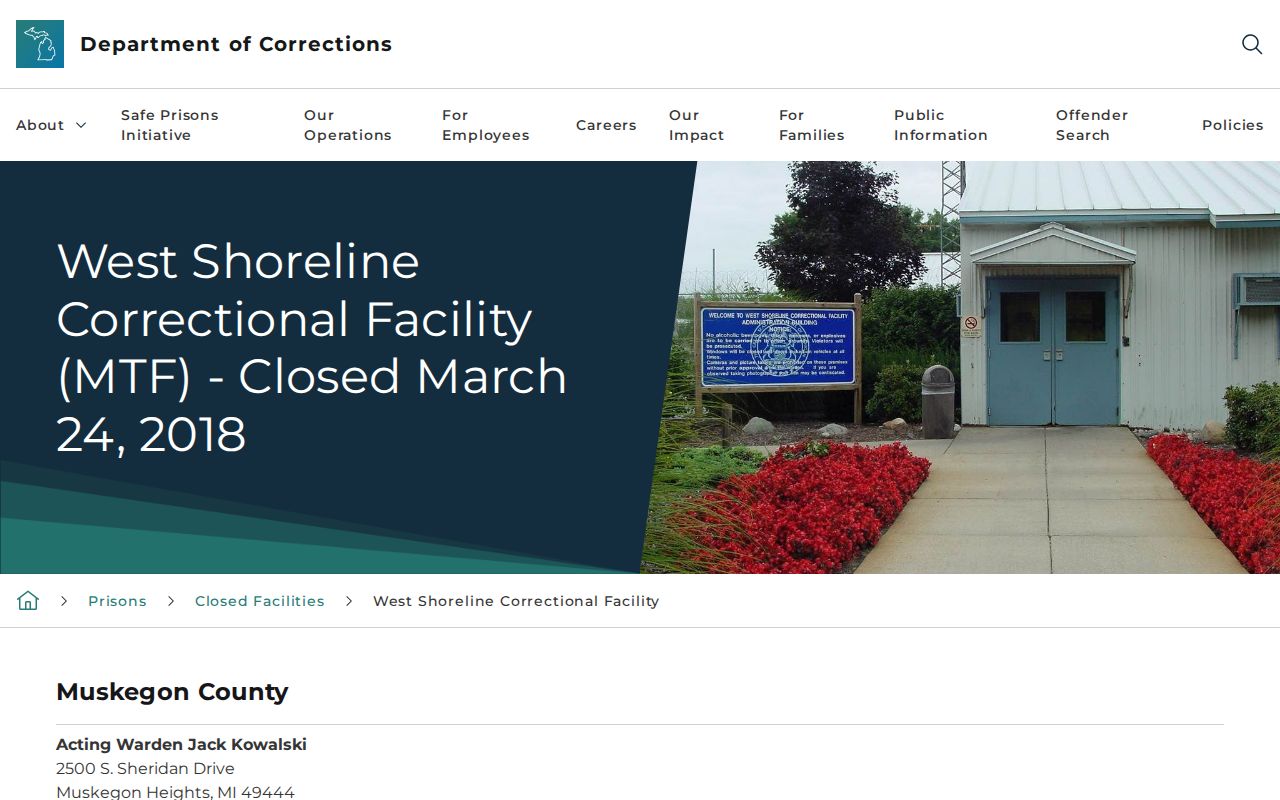
The source proves that MTF is closed. It does not reveal a former prisoner’s later transfer, parole, or discharge without a person-specific MDOC record.
West Shoreline and Brooks
West Shoreline shared services with the neighboring Brooks prison. Both are tied to 2500 S. Sheridan Drive in Muskegon Heights in the research sources, but their present status differs. Brooks is active and houses multiple security levels. West Shoreline is closed. A record that lists the address alone is therefore not enough to identify the institution or the person’s release route.
Use the facility code, date, and full official name. If an event occurred after March 24, 2018, West Shoreline cannot be the active releasing institution. It may still appear as prior location history. Contact MDOC when movement records are needed to connect the old MTF placement to a later Brooks or other prison record.
Note: A shared address or service arrangement does not make West Shoreline and Brooks the same facility or merge their histories.
Muskegon Custody Source Check
The county contains a 542-bed Sheriff jail and two active MDOC prisons, while West Shoreline adds a closed state-prison name to older files. Each source has a different release record. Sheriff Records documents a county booking episode. MDOC records document state-prison transfers, parole, and discharge. A court docket explains the sentence and later orders but may not show the precise physical departure time.
Federal and immigration custody require still other locators. A no-match in OTIS cannot prove freedom from all authorities. Identify the custodian named in the last sound record, then follow that authority’s chain. The Muskegon County released-inmate search compares county, state, federal, and court sources when the trail crosses systems.
Verify Old MTF Discharges
For an old MTF case, the strongest proof is often a certified MDOC discharge record paired with the sentencing-court judgment. OTIS may still help when the person has another active state case or a recent discharge. The fact that the old West Shoreline entry has disappeared from the public search should be reported as a coverage limit, not as evidence that the sentence or prison placement never existed.
Keep a research log with the source, date searched, identifiers used, and exact field wording. If the name is absent, record that result without guessing. If a transfer is shown, continue to the receiving facility. If parole is shown, verify supervision. If discharge is shown, make sure it belongs to the same sentence under review. That method turns a closed-facility clue into a defensible historical release trail.
Several records may be needed for a complete timeline. An institutional movement entry ties MTF to the next prison. A Notice of Decision records a Parole Board result, but a grant may precede physical release. Date Paroled records the later parole event, and a discharge certificate documents the end of the sentence or supervision identified in that record. Keeping those stages separate is especially important when the prison itself closed between the original placement and the final discharge.
Older paper records may abbreviate names or omit a modern location. Use the MDOC number to bridge those differences. When no number is available, compare the sentence, offense, court, birth details, and dates before treating two records as the same person.