
Muskegon Projected Versus Actual Release
A projected date is a calculation or legal milestone based on facts available now. It is not proof that a person left custody. In an MDOC record, Earliest Release Date usually marks the point at which the Michigan Parole Board gains jurisdiction. The Board may grant parole at that point, act later, or deny release. Maximum Discharge Date is the potential outer end of the sentence if no other sentence or hold provides authority.
Date Paroled is different. It records departure from prison or the start of parole status in a nonsecure placement. At the county jail, the court's order and calculated term create the expected path, but the Sheriff's release transaction best records the actual custody event. Administrative processing, another warrant, or transfer can separate the court date from the physical exit time.
Scheduled versus actual: Never report an OTIS Earliest Release Date, a court order, or a bond payment as proof that a Muskegon County inmate was physically released.
A pretrial detainee does not have a sentence-based projected release date. Bond may be posted, changed, denied, or followed by an outside hold. The court docket shows legal action. The jail record or VINE custody event addresses what happened next.
A Muskegon bond receipt proves payment of one bond, not release. The Sheriff warns that another jurisdiction's hold can prevent departure even after the Muskegon obligation is satisfied. Personal recognizance also removes the payment step without guaranteeing that all holds have cleared. When timing matters, compare the signed order, the time jail staff processed it, and the physical release transaction. Those can be three different moments.
Find Muskegon Projected Release Dates
Begin with custody type. The county portal and Sheriff Records apply to the Muskegon County Jail. The OTIS offender search applies after commitment to MDOC and also covers parolees, probationers under MDOC, and recent discharges. It does not calculate a routine jail-only sentence.
- Identify the person with full name, birth information, booking or MDOC number, case number, sentencing court, and approximate custody dates.
- Open the D60 or C14 criminal case. Read the Judgment of Sentence, jail-credit entry, amendments, and whether terms run at the same time or one after another.
- For county custody, check the Muskegon inmate portal, then ask Sheriff Records at 231-724-6351 to confirm the computed date and any hold or release transaction.
- For state prison, search OTIS by MDOC number when possible. Compare identifiers, open every sentence block, and record Earliest Release Date and Maximum Discharge Date exactly as labeled.
- Check status and Date Paroled. A parole status confirms a different event from eligibility. An active prison status means the projected date has not established release.
- Resolve court-derived errors with the sentencing court. Resolve MDOC calculation or supervision questions through MDOC and the office shown in the record.
The wider Muskegon County released inmate lookup covers the full chain when it is not clear whether the person bonded out, completed a term, transferred to prison, or moved to another authority.
Muskegon OTIS Release Date Fields
OTIS draws sentence data from the Judgment of Sentence. Search by MDOC number if available because names can collide. A name search must be checked against date of birth, sentencing county, offenses, and photograph when one exists. Read every active and discharged sentence. A record with several cases can contain overlapping minimums, maximums, or different discharge states.
| OTIS field | Meaning | What it does not prove |
|---|---|---|
| Earliest Release Date | Parole Board jurisdiction point for the applicable sentence | A grant or completed release |
| Maximum Discharge Date | Potential sentence end if no other authority controls | That no other sentence or hold exists |
| Date Paroled | Departure from prison or acquisition of parole status | End of MDOC supervision |
| Discharge information | End of MDOC jurisdiction for the identified sentence | Closure of an unrelated case |
The official MDOC release-date definitions and OTIS guidance are captured below. The current source should control if fields or policy explanations change.
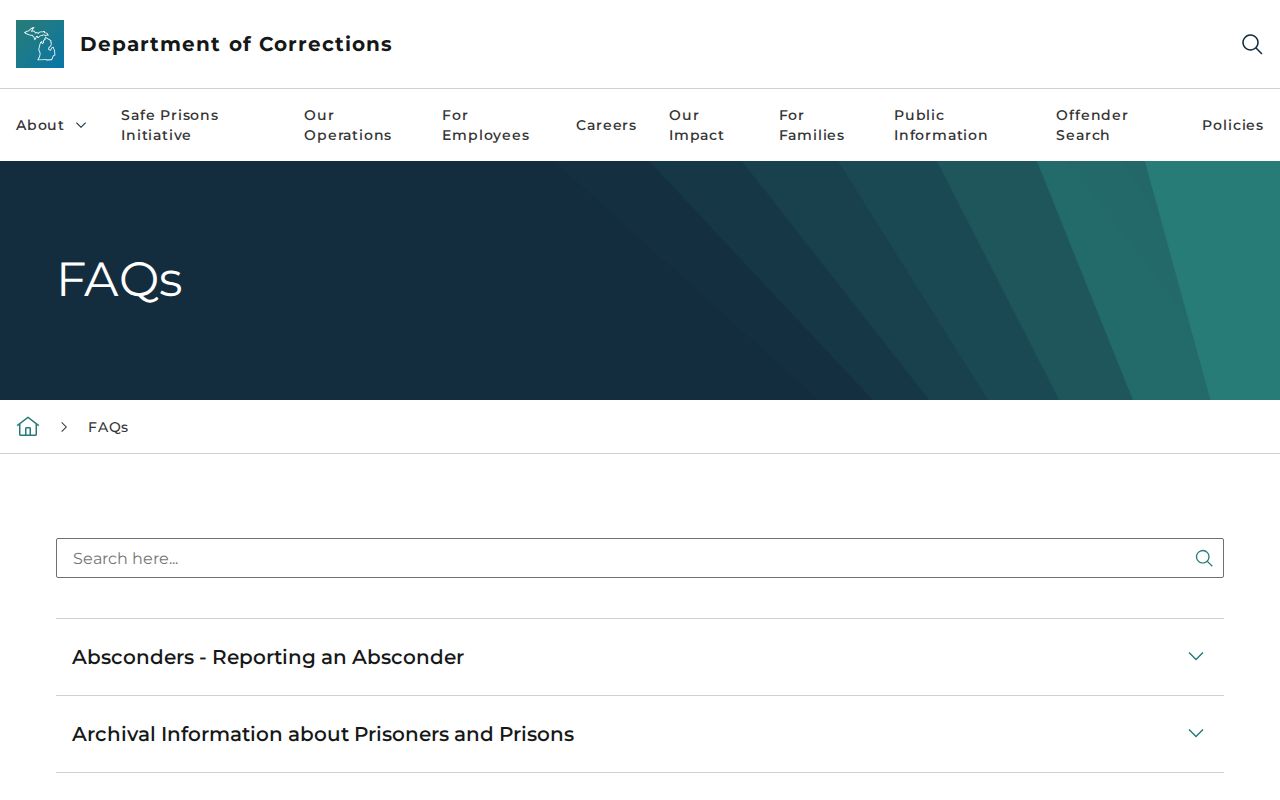
These labels prevent an eligibility date from being mistaken for the date a person actually left a Muskegon-area prison.
Michigan Truth-in-Sentencing Release Dates
Michigan is not an “85 percent” truth-in-sentencing state for the covered minimum term. MDOC states that a covered prisoner must serve 100 percent of the judicially imposed minimum in prison before parole consideration. The rule applies to listed assaultive offenses committed on or after December 15, 1998, and other covered crimes committed on or after December 15, 2000. It removed good-time and disciplinary credits against the minimum for those cases.
The consequence is direct. Programming, good conduct, or an optimistic estimate does not move the public Earliest Release Date below the covered judicial minimum. Major misconduct may still matter through disciplinary time and Parole Board review. MCL 800.34 governs disciplinary time for truth-in-sentencing prisoners. It is not a simple credit that can be subtracted with a public calculator.
The MDOC truth-in-sentencing explanation is shown in the matching manifest image.
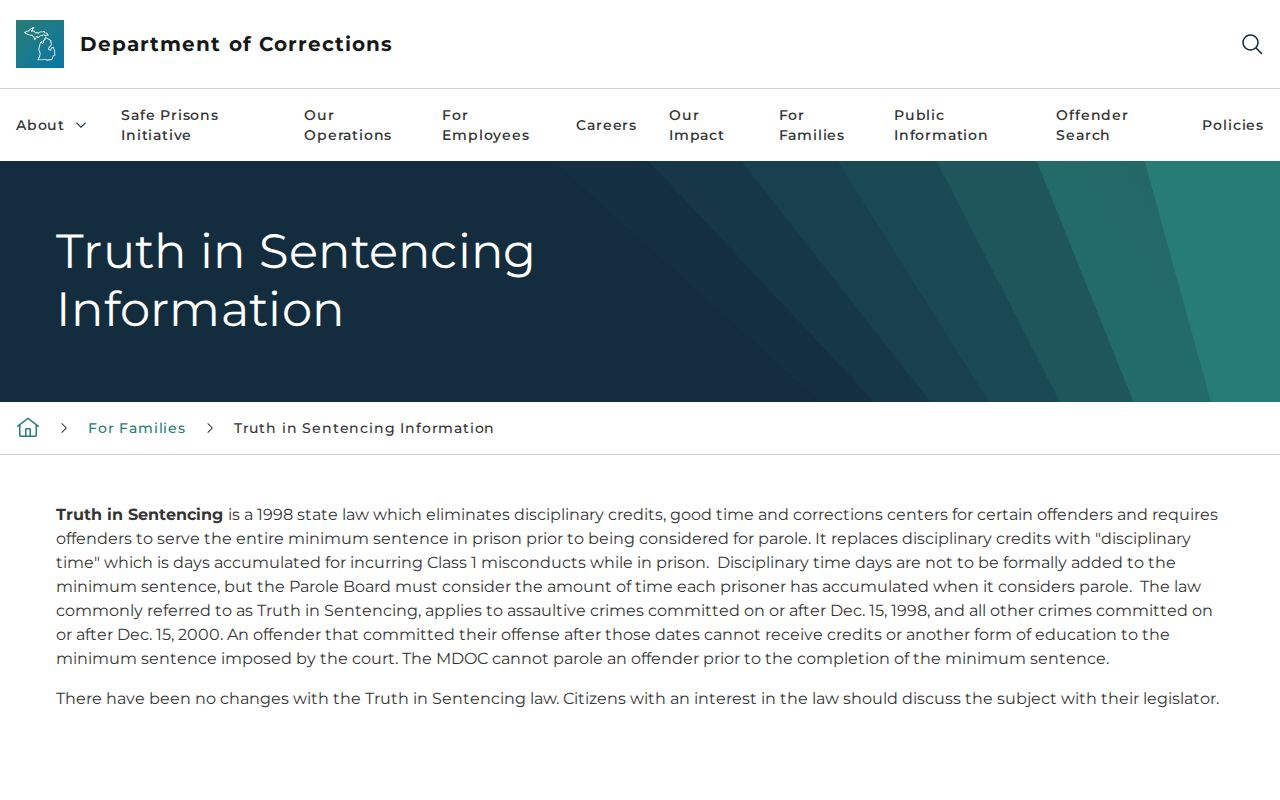
Use the offense date and current statute before deciding which Michigan sentence regime applies.
Note: A pending legislative proposal is not a credit. Only enacted law and the applicable judgment belong in a release-date calculation.
Muskegon Legacy Credit Calculations
Older eligible offenses can fall under preserved good-time or disciplinary-credit systems. MCL 800.33 and MDOC Policy 03.01.100 address those legacy cases. The historical regular-good-time schedule rises by statutory service bands: five days per month in years one and two, then six, seven, nine, ten, twelve, and ultimately fifteen days in later bands. Eligibility, conduct, forfeiture, restoration, and the precise offense date all matter.
Those rules are grandfathered. They are not a new earned-time program open to all current prisoners. A person reading an old record should not copy a credit figure into a newer truth-in-sentencing case. MDOC sentence staff apply the governing law and the court judgment. If the court data is wrong, the sentencing court must address it. If the public MDOC display conflicts with the controlling documents, preserve the result and ask MDOC Records for clarification.
- Judicial minimum
- The minimum prison term imposed by the sentencing court.
- Parole jurisdiction
- The point when the Board may consider release, not a release guarantee.
- Legacy credit
- A good-time or disciplinary-credit rule preserved for an eligible older offense.
- Detainer
- A request or legal hold from another authority that can prevent community release.
Muskegon Jail Good-Behavior Dates
County-jail sentences use a different Michigan law. MCL 51.282 provides a one-day reduction for each six days of sentence when the county-jail prisoner has no rule violation. The Sheriff may set forfeiture rules, remove accumulated allowance for insubordination, and restore some or all after a minor infraction as a reward for especially good conduct. MCL 51.283 requires posting of the applicable rules and allowances.
That county allowance must not be mixed with MDOC's truth-in-sentencing minimum or a legacy prison-credit schedule. Nor should anyone publish a calculator that merely divides the sentence by seven. The real Muskegon County projected release date can depend on the commitment start, pre-sentence jail credit, partial days, concurrent or consecutive terms, loss or restoration of allowance, an amended order, and another agency's hold.
The current county-jail good-behavior statute is captured below.
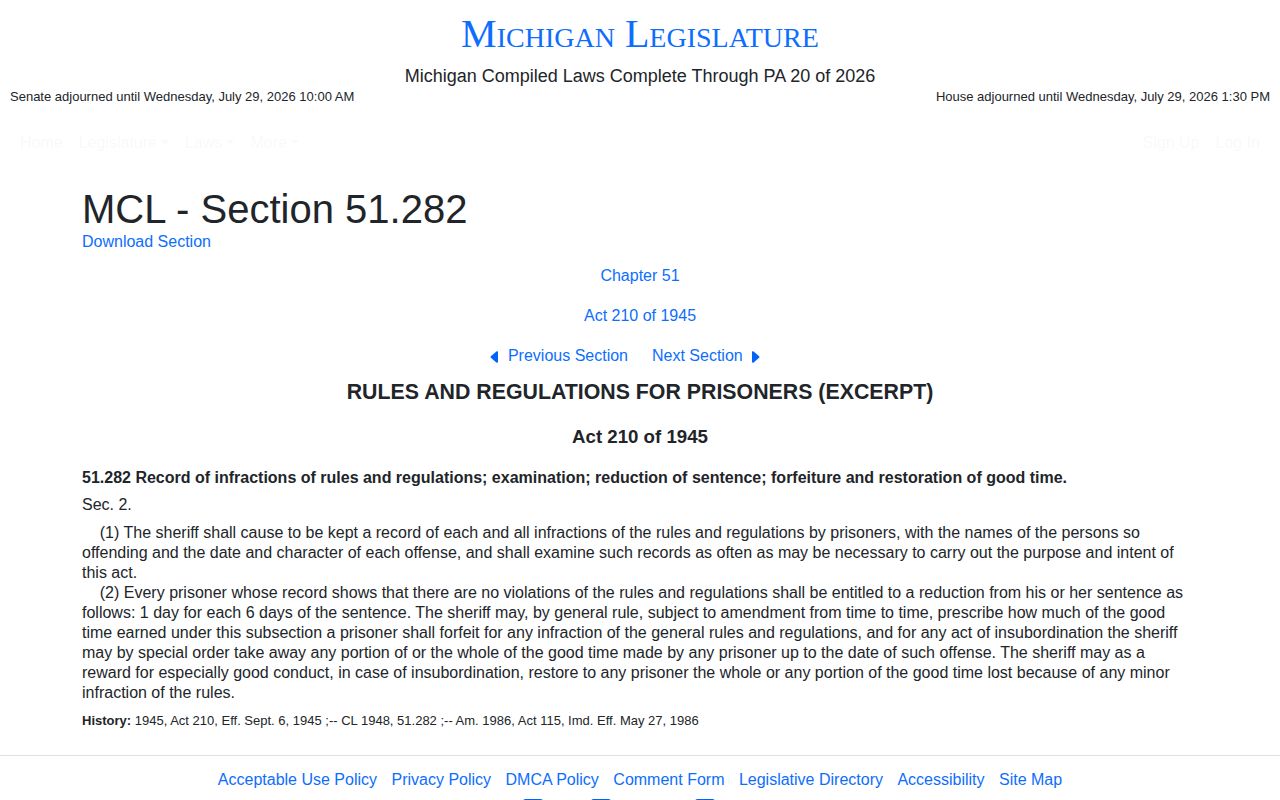
Confirm the applied allowance with Muskegon County Jail records and the judgment rather than estimating from the image alone.
Why Muskegon Release Dates Change
A public date can move because the input changed, a later legal event controls, or the date was never an actual-release promise. The reason should be traced to the agency with authority over that part of the record.
| Factor | Possible effect | Where to verify |
|---|---|---|
| Amended judgment or jail credit | Changes the sentence calculation | D60 or C14 clerk, then jail or MDOC |
| Consecutive sentence | Moves the controlling end date | Judgment and all OTIS sentence blocks |
| County allowance loss or restoration | Changes a jail-term estimate | Muskegon County Jail records |
| Legacy credit forfeiture | May change an eligible older prison term | MDOC sentence records |
| Parole grant or denial | Controls departure after eligibility | Board notice, OTIS, MDOC |
| Outside hold or detainer | Can cause continued custody or transfer | Jail, court, and receiving authority |
| Transfer processing | Creates a gap between systems | Sending and receiving agencies |
A passed maximum date paired with an unchanged status requires agency review, not a public conclusion of unlawful detention. Another sentence, hold, amended order, or update delay may explain it. Preserve the record and contact MDOC and the sentencing court.
Michigan court and corrections records answer different parts of the question. The Judgment of Sentence supplies the legal term and credit ordered by the judge. MDOC applies the governing prison-sentence law and records its public fields. Muskegon County Jail applies the county rule to a county commitment. A VINE message reports an agency event. Reconciling those sources is safer than selecting the date that appears most favorable.
Three Muskegon Release Moments
Earliest Release Date, Date Paroled, and Discharge Date tell a sequence. The earliest date opens parole jurisdiction. Date Paroled records the move out of prison into parole status. Discharge ends MDOC authority for that sentence. A person can live in Muskegon County after the second date while still being supervised, then reach discharge much later.
This three-date distinction also explains why a projected date should not be copied into a statement that someone “got out.” A favorable Board decision still requires placement and release processing. MDOC says at least 28 days is required between the decision and physical release, and a grant can be suspended if adverse information arises. The completed event belongs in OTIS Date Paroled, a VINE event, or the agency record.
Confirm Muskegon Actual Release Dates
For county custody, request the booking-and-release transaction from the Sheriff. Ask for booking number, booking and release times, release disposition or transfer destination, and releasing authority. Michigan FOIA, MCL 15.231 et seq., supplies a request path subject to exemptions and fees. A narrow request with a known name, date of birth, case number, and date range is more useful than a broad demand.
For state custody, check OTIS status and Date Paroled, then contact MDOC when a certified record is needed. For timely notice, register with MI-VINE release notifications. VINE is a prompt alert from a participating source, not a certified release calculation. Save the event type, agency, and timestamp, then verify it with the Sheriff, MDOC, or the receiving agency if the event says transfer.