
Muskegon Jail Release Paths
A Muskegon County Jail booking can end in several ways. A person may leave on cash, surety, or personal-recognizance bond, finish a jail term, receive a court-authorized release, or move to another authority. The Sheriff’s bond information warns that payment does not override a hold from another jurisdiction. A paid bond receipt therefore proves payment, not physical release. The next custody source must still be checked.
A “ride out” is a transfer, not a community release. Someone committed to the Michigan Department of Corrections moves into state custody and should later appear in OTIS. A transfer to another county requires that county’s roster or records office. When the person truly leaves jail custody for the community, the Muskegon Sheriff release transaction, a VINE release event, and the related court docket form the strongest public chain of proof.
Federal and immigration transfers need separate checks. Muskegon County has no identified active BOP prison or dedicated ICE detention center. A sentenced federal person is traced through the BOP Inmate Locator, while a federal pretrial transfer may require the U.S. Marshals district or the court file. ICE uses its own detainee locator. None of those systems turns a county-roster disappearance into proof of community release.
| Jail outcome | Best next source |
|---|---|
| Community release | Sheriff release record and VINE |
| MDOC transfer | OTIS after state intake |
| Other county transfer | Receiving jail or records office |
| Bond posted with a hold | Sheriff Records and the holding agency |
Confirm a Muskegon Jail Release
The Muskegon inmate portal is the first current-custody check. Search the exact name and compare any visible age, date of birth, arrest date, charge, and holding-agency details. A current row supports continued county custody. No row is only a clue. Spelling, a fast transfer, portal delay, or a different custody system can also cause a no-match result.
Use a short verification sequence so each source answers the right question:
- Check the live portal and save the time searched.
- Search Michigan VINE for a release or transfer event from the reporting jail.
- Read the D60 case, and C14 too if a felony was bound over.
- Check OTIS when the court committed the person to MDOC.
- Request the Sheriff booking and release transaction when formal detail is needed.
Muskegon Jail Release Records
A former booking episode belongs with the Muskegon County Sheriff’s records channel, not the current-inmate search alone. A narrow request should name the person, add a date of birth or booking number when known, define the booking-date range, and ask for the booking and release transaction. Useful fields include booking and release times, the release disposition, charges, bond details, and any transfer destination shown in the releasable record.
The Sheriff FOIA page routes public-record requests. Sheriff Records is at 990 Terrace Street on the first floor in Muskegon, phone 231-724-6351, with weekday counter hours from 8:00 a.m. to 4:30 p.m. and a noon to 1:00 p.m. closure. Michigan FOIA generally calls for a response within five business days, with one permitted ten-business-day extension. That response may grant, partly grant, deny, or state that more time or a deposit is required.
Muskegon County Sheriff Records990 Terrace Street, first floor
Muskegon, MI 49442
231-724-6351
Monday-Friday, 8:00 a.m.-4:30 p.m.
Closed noon-1:00 p.m.
Read Muskegon Release Fields
No fixed public released-row field set is promised by Muskegon County. The portal software can expose a Release Date control and fields for name, race, sex, cell block, arrest date, holding agency, custody date, mugshot, date of birth or age, and hold reasons when the local configuration supplies them. Those interface options do not prove that every released record remains public or that every field is complete.
For a clear request, tie the release data back to one booking episode. A release date identifies when that episode ended. Release type or disposition explains the stated route, while a destination may show a jail, MDOC, or other authority. The booking number prevents confusion with another arrest. Charges and bond terms give context, but a court order can change after the portal record was made. The originating Sheriff record and chronological court docket should be reconciled before reaching a conclusion.
- Release
- Departure from this county booking episode.
- Transfer
- Movement to another custodian, not freedom from custody.
- Detainer
- A request or legal basis for another authority to hold or take the person.
- Time served
- A sentence treated as complete through credited custody time.
Muskegon Bond Release Checks
Muskegon publishes cash-only, cash-or-surety, and personal-recognizance bond methods. The Hall of Justice kiosk accepts payment around the clock, but kiosk access is not the same as immediate release. Staff must verify the order, complete processing, and test for other holds. A recognizance release does not require cash or a surety bond, yet it still depends on the court’s order and the absence of another lawful custody basis.
After payment, keep the receipt and check the Sheriff source again. If the person remains listed, ask whether processing is pending or whether an outside hold controls. Court dockets help confirm the bond order, but they rarely show the exact moment the person crossed the jail exit. VINE may later report the custody change. Sheriff Records supplies the formal Muskegon jail transaction when the time and disposition must be documented.
Note: A 24/7 payment kiosk describes payment access, not a guaranteed physical release time or a published same-day release feed.
Muskegon Release Property Deadlines
The jail’s property rules offer a useful transfer clue. When a person rides out to prison or another agency, only property accepted by the receiving authority goes along. Before departure, the person must authorize someone to collect items left at Muskegon County Jail. The jail holds that property no longer than 15 days after release, so an authorized person should act promptly and confirm current pickup rules with jail administration.
Ordinary property release is narrower while someone remains in custody. The published rule permits keys to be released within 72 hours of incarceration during stated weekday periods. That “72 hours” concerns keys, not a list of people released during three days. Clothing and other property rules depend on the custody outcome. Property pickup can support the story of a transfer, but it is not itself a certified release record.
Inside Muskegon County Jail
The Sheriff Corrections page says the jail opened in 2015 and has 542 beds. It operates continuously and includes medical, laundry, and kitchen functions. The kitchen produces more than 200,000 meals per year. These figures describe a large county jail operation. They do not establish how many people were released in a year, an average stay, or a specific release hour, none of which the official sources published.
Jail administration is led by Lieutenant Nate Stephenson at 990 Terrace Street, Suite 450, Muskegon, phone 231-724-7113. The jail’s round-the-clock operation should not be read as round-the-clock records-counter service or a rolling 24-hour release list. The records office maintains separate public hours, and the online portal has no published refresh cadence or released-row retention period.
The facility is also only one part of Muskegon’s dense correctional landscape. Two active MDOC prisons operate on Sheridan Drive, while the former West Shoreline prison appears in older records. Before choosing a search tool, identify whether “in Muskegon” meant county jail custody or a state-prison placement.
View Muskegon Jail Records
The official Muskegon County Corrections source shows the facility and directs visitors toward county custody services.
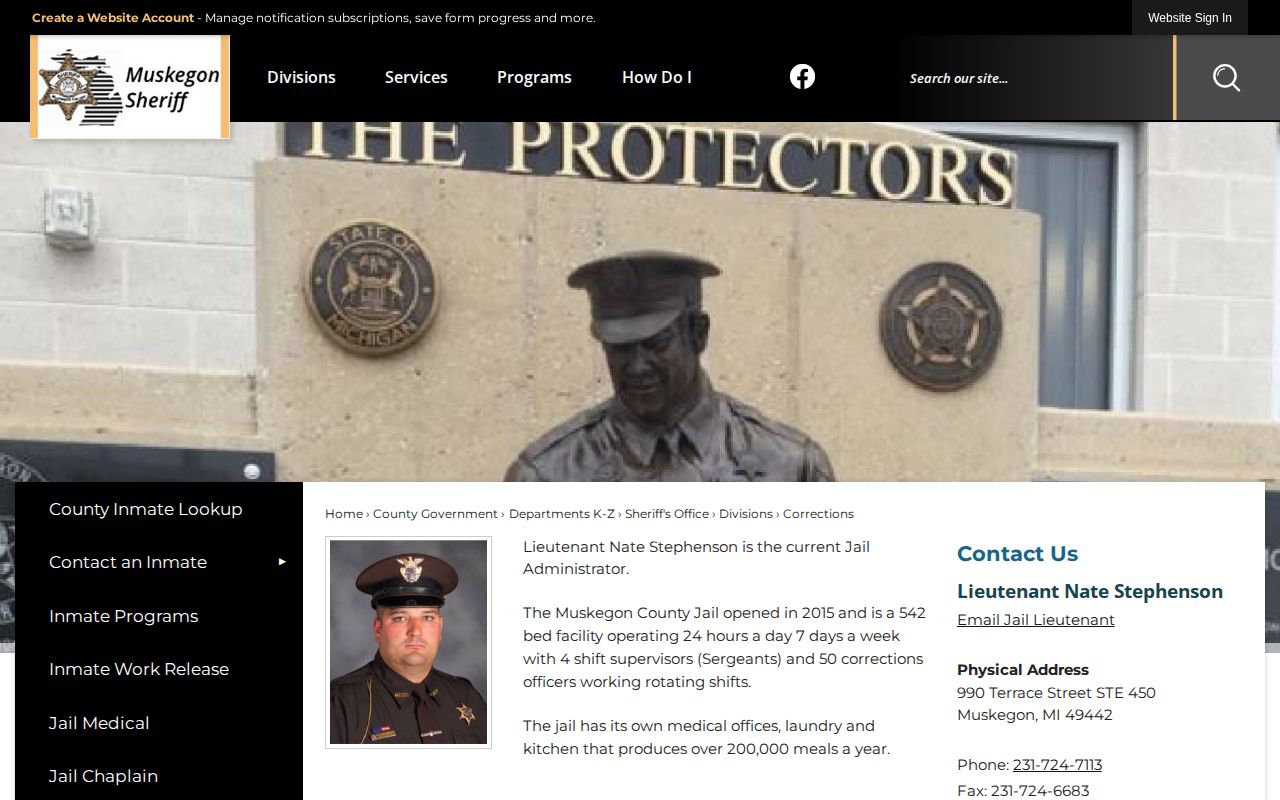
The source supports the jail identity and administrative facts, while a person-specific release still requires the portal, VINE, court record, or Sheriff transaction.
For full county search and release-record coverage, use the Muskegon County released-inmate search. It separates county, state, federal, and immigration custody so that a transfer is not mistaken for a community release.
Two Muskegon courts can also matter. Adult criminal cases begin in the 60th District Court, while a felony continues in the 14th Circuit Court after bindover. The dockets can show bond, dismissal, sentence, probation, or commitment orders. They do not usually state the exact physical exit time. Pair the judicial event with the Sheriff transaction when the release moment or destination must be established.
Save the search date and the exact agency wording. Public custody data can change, while a preserved Sheriff or court record shows what the source reported for that booking episode.