
MCF Release Paths
Muskegon Correctional Facility is an active MDOC Level II prison for adult men. Leaving MCF does not always mean leaving state custody. A prisoner may be paroled to community supervision, discharged at the maximum date, transferred to another MDOC prison, or moved into an approved nonsecure setting while still under legal control. The facility name on an older document identifies a place in the sentence, not the final custody outcome.
OTIS, the Offender Tracking Information System, is the main public source. It covers current Michigan prisoners, parolees, and probationers under MDOC supervision and people discharged within the prior three years. A parole record may show Date Paroled, current status, and a supervising location. A discharged record may show the discharge date for the sentence. A prison status or a different assigned facility indicates continued state custody, even if MCF no longer holds the person.
| MCF departure | Meaning | Confirmation |
|---|---|---|
| Parole | Leaves secure prison under supervision | OTIS status and Date Paroled |
| Discharge | MDOC authority ends for that sentence | OTIS discharge field or MDOC record |
| Prison transfer | Custody continues elsewhere | OTIS assigned facility |
| Older history | May fall beyond public OTIS retention | MDOC records and sentencing court |
Confirm an MCF Release
Open the OTIS application and use the MDOC number when known. It is more precise than a name. Otherwise search the surname and given name, then compare date of birth, photograph when available, sentencing county, offenses, and sentence dates. Open the detail record instead of relying on the result list. Similar names and multiple sentences make that final match essential.
Read all active and discharged sentences. One discharged case does not cancel a different active case. Save the exact current status and the date searched, then note the assigned location. A field office is not a home address. If the record says parole, record Date Paroled and the supervising office. If it says discharged, record the relevant discharge date. A transfer should lead to the new prison, not to an assumption of community release.
- Search by MDOC number or exact name.
- Match birth, offense, county, and photograph details.
- Read every sentence and the Current Status field.
- Compare Earliest Release, Maximum Discharge, and Date Paroled.
- Contact MDOC Records when the public record is absent or unclear.
Read MCF Release Dates
Michigan does not publish one guaranteed projected date. OTIS distinguishes Earliest Release Date, Maximum Discharge Date, and Date Paroled. The earliest date comes from the judgment and applicable sentence law. It marks when the Parole Board may act. The Board can grant release at or after that point, deny parole, or reconsider later. The maximum date is the potential end of the sentence if no other sentence or hold supplies custody authority.
Date Paroled is tied to an actual parole event. Parole means the person left secure prison but remains subject to MDOC conditions. Discharge means supervision has ended for the identified sentence. These labels should be copied exactly. Consecutive sentences, amended judgments, misconduct, legacy credits, detainers, placement processing, and Parole Board action can explain why the public dates do not produce a simple expected exit day.
Michigan truth-in-sentencing rules also limit shortcut calculations. For covered offenses, MDOC states that the judicially imposed minimum must be served in prison before parole consideration. The rule is not an 85-percent formula. Eligible older offenses can follow legacy good-time or disciplinary-credit law, but those grandfathered systems should not be applied to a modern sentence without confirming the offense date and statute. OTIS remains a display of official calculations, not a do-it-yourself release calculator.
- Parole
- Community release while MDOC supervision continues.
- Discharge
- End of MDOC authority for the stated sentence.
- Maximum date
- Potential sentence end if no other authority controls.
- Detainer
- A basis for another authority to take or continue custody.
MCF Records and Contact
The official MCF page lists the facility at 2400 S. Sheridan Drive in Muskegon and phone 231-773-3201. Facility staff can route current institutional questions, but an older offender history or certified release packet belongs with MDOC Records. The county Sheriff does not own MCF release data, and a county FOIA request should not be used for a state-prison record.
Muskegon Correctional Facility2400 S. Sheridan Drive
Muskegon, MI 49442
231-773-3201
Michigan Department of Corrections
For older or formal material, MDOC identifies its records and FOIA channels through the department contact page. General MDOC contact is 517-335-1426 and CorrectionsInfo@michigan.gov. The FOIA office is 517-335-4194 and MDOC-FOIA@michigan.gov. A narrow request should include the full name, MDOC number, date range, facility, and the exact release, parole, discharge, or transfer record sought.
MCF Parole and Discharge
The Michigan Parole Board is the state’s paroling authority for felony prisoners committed to MDOC. A favorable decision starts release processing but is not the physical release itself. MDOC says placement and release processing requires at least 28 days between the decision and physical departure, and later misconduct or adverse information can suspend a grant. Public event notices mainly concern specified lifer-parole and clemency hearings, not one full calendar of ordinary interviews.
After parole, OTIS may list a Muskegon field office or another assigned location. Muskegon’s parole office is separate from its probation office. Conditions and exact addresses are not a reason to infer a person’s home. When the sentence reaches discharge, OTIS may retain the record for three years. After that window, a no-match can reflect ordinary removal rather than proof that the person never served time at MCF.
For a formal end-of-sentence record, ask MDOC about a discharge certificate or certified PENPACK. The department describes the PENPACK as a commitment and discharge packet. A court judgment explains the sentence imposed, while the MDOC packet records corrections custody. Reading both resolves many disputes caused by amended judgments, jail credit, or several sentence rows. The MCF public facility page cannot replace either person-specific record.
Note: A Parole Board grant, an OTIS earliest date, and a Date Paroled are three different events and should never be merged.
MCF Reentry Programs
MCF’s official profile lists prerelease and reentry programming alongside education and treatment. That local work can prepare eligible prisoners for a transition, but a program listing does not prove that a named person took part, completed it, or received parole. Release remains governed by the person’s sentence, the Board process where applicable, placement approval, and any other legal custody basis.
Nearby Earnest C. Brooks Correctional Facility also publishes reentry work. In 2025, Brooks hosted Reentry United with the Parole Board, education and reentry staff, and partner groups. The event shows the depth of reentry activity in Muskegon’s state-prison corridor. It does not create a released-person list. Current status still comes from OTIS and official MDOC records.
Muskegon Prison Geography
Muskegon’s correctional geography is unusually dense. MCF and Brooks are active MDOC prisons on Sheridan Drive. West Shoreline shared services with Brooks before closing in 2018. The county also operates a large Sheriff jail. An old note that someone was “in Muskegon” may therefore point to county custody, an active state prison, or a closed historical facility.
Choose the database by operator. The Sheriff portal and Sheriff release transaction cover the county jail. OTIS and MDOC Records cover MCF, Brooks, and state-prison history. The sentencing court supplies judgments and later correcting orders. The Muskegon County released-inmate lookup maps those paths when the original custodian is uncertain.
View MCF Release Sources
The official Muskegon Correctional Facility profile confirms its active status, security level, contact information, and programming.
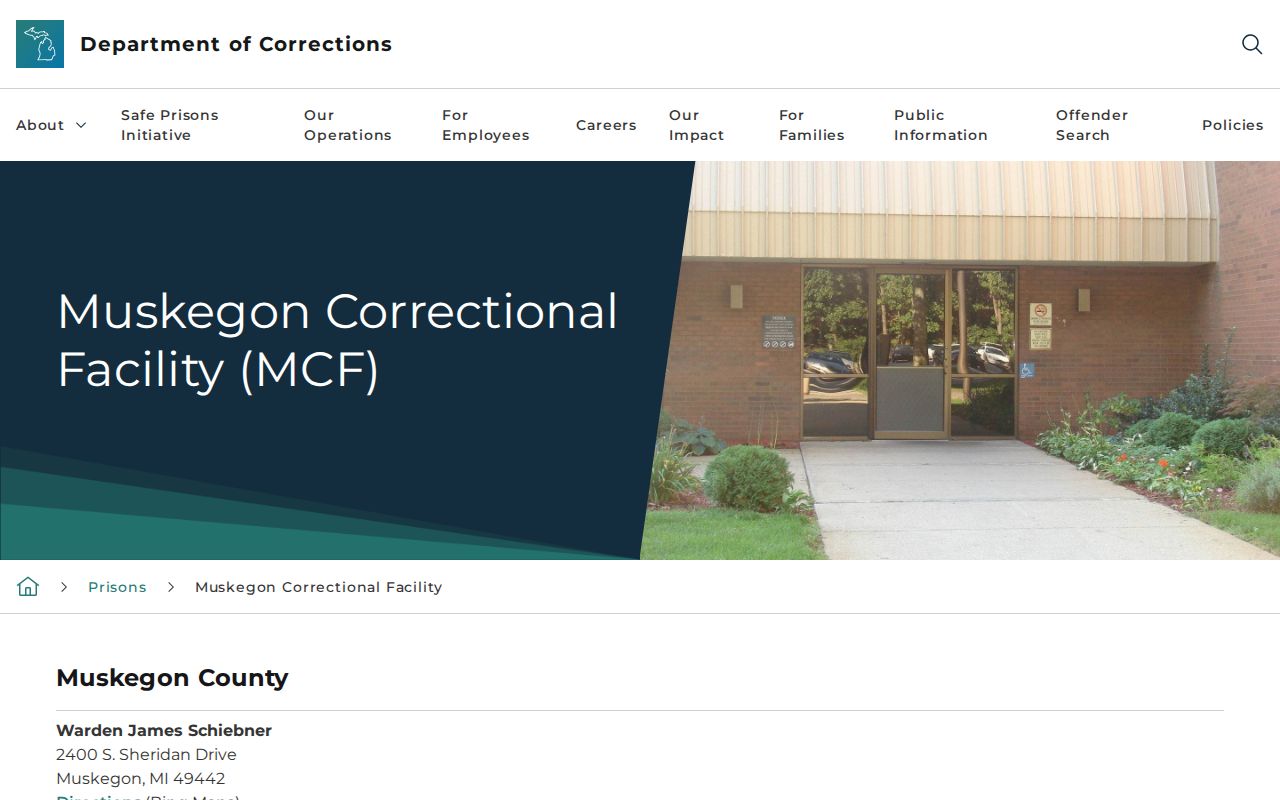
The profile establishes the facility context. OTIS and MDOC records remain the person-specific sources for a parole, discharge, or transfer.
A photo or facility profile should never be used as present-status proof. Match the MDOC number and current OTIS fields on the day of the search. If OTIS shows a field office, the person may be on parole or probation. If it shows another institution, custody continued through transfer. If the person is absent beyond the discharge-retention period, the correct next step is an MDOC record request, not a Muskegon County jail search.