
Muskegon Parole and Probation
Parole, probation, and discharge mark three different legal positions. A person on parole has left an MDOC prison, such as Muskegon Correctional Facility or Earnest C. Brooks Correctional Facility, but remains in Michigan Department of Corrections custody while living in the community. A parole order sets the conditions. The Michigan Parole Board decides whether an eligible prisoner may move to parole, while an assigned field agent handles supervision.
Probation comes from a sentencing court. MDOC generally supervises felony probation, but Muskegon County also has a separate 60th District Court probation office for district-court matters. Discharge means the displayed sentence and its MDOC supervision have ended. It does not decide an unrelated case, registry duty, or another authority's hold.
| Status | Who imposes it | Best public check | What release means |
|---|---|---|---|
| Parole | Michigan Parole Board | OTIS status, Date Paroled, assigned office | Out of prison, still under MDOC control |
| Felony probation | Sentencing court | OTIS plus the 14th Circuit record | In the community under a court order |
| District probation | 60th District Court | D60 case record and local probation counter | Local court supervision, not MDOC parole |
| Discharged | End of the sentence or supervision term | OTIS discharge field or certified MDOC record | MDOC jurisdiction ended for that sentence |
- Parole
- Community supervision after release from a state prison.
- Probation
- A court-ordered period of supervision that may follow or replace confinement.
- Discharge
- The end of MDOC jurisdiction for the identified sentence.
- Absconder
- A person reported as having stopped required contact with supervision and whose location is not established by the office record.
Verify Muskegon Post-Release Supervision
The Michigan OTIS application covers prisoners, parolees, and probationers currently under MDOC authority, along with people discharged during the preceding three years. It does not cover a jail-only sentence or every district-court probation case. A name missing from OTIS is therefore not proof that the person has no Muskegon County supervision.
- Collect the full name, date of birth, MDOC number when known, sentencing county, and case number. The MDOC number is the strongest search key.
- Search OTIS. Open the matching detail after comparing birth information, offenses, sentencing county, and photograph when available.
- Read Current Status, Assigned Location, and every active and inactive sentence. Do not let an old discharged case hide a second active case.
- For felony probation, compare OTIS with the 14th Circuit Court case record. For a district case, use the 60th District Court search.
- Call the office tied to the displayed record when the status, reporting instructions, or discharge date needs confirmation. A field-office address is not the person's residence.
- Request a certified court order or an available MDOC record when formal proof is required. The public display is useful, but it can change.
A Muskegon County release record proves departure from a custody episode. It does not by itself prove that parole or probation ended.
The broader Muskegon County released inmate search explains how to reconcile the jail transaction, court order, VINE event, and OTIS status when the custody path is unclear.
Muskegon Supervision Offices Differ
Muskegon has three relevant counters, and they are not interchangeable. The MDOC Region 4 directory lists a county parole office and a separate county probation office. District-court probation is operated through the 60th District Court. Match the agency name in OTIS or the sentencing court on the docket before calling.
Muskegon County Parole Office
985 E. Barney Street
Muskegon, MI 49444-1705
231-728-3926
Muskegon County Probation Office
131 E. Apple Avenue
Muskegon, MI 49442-3357
231-724-6345
60th District Probation
990 Terrace Street, Suite 100
Muskegon, MI 49442
231-724-6238
Monday-Friday, 8:30 a.m.-4:30 p.m.
The MDOC image below comes from the official Region 4 parole and probation directory. It is a route to current office listings, not evidence that a named person reports to a particular building.
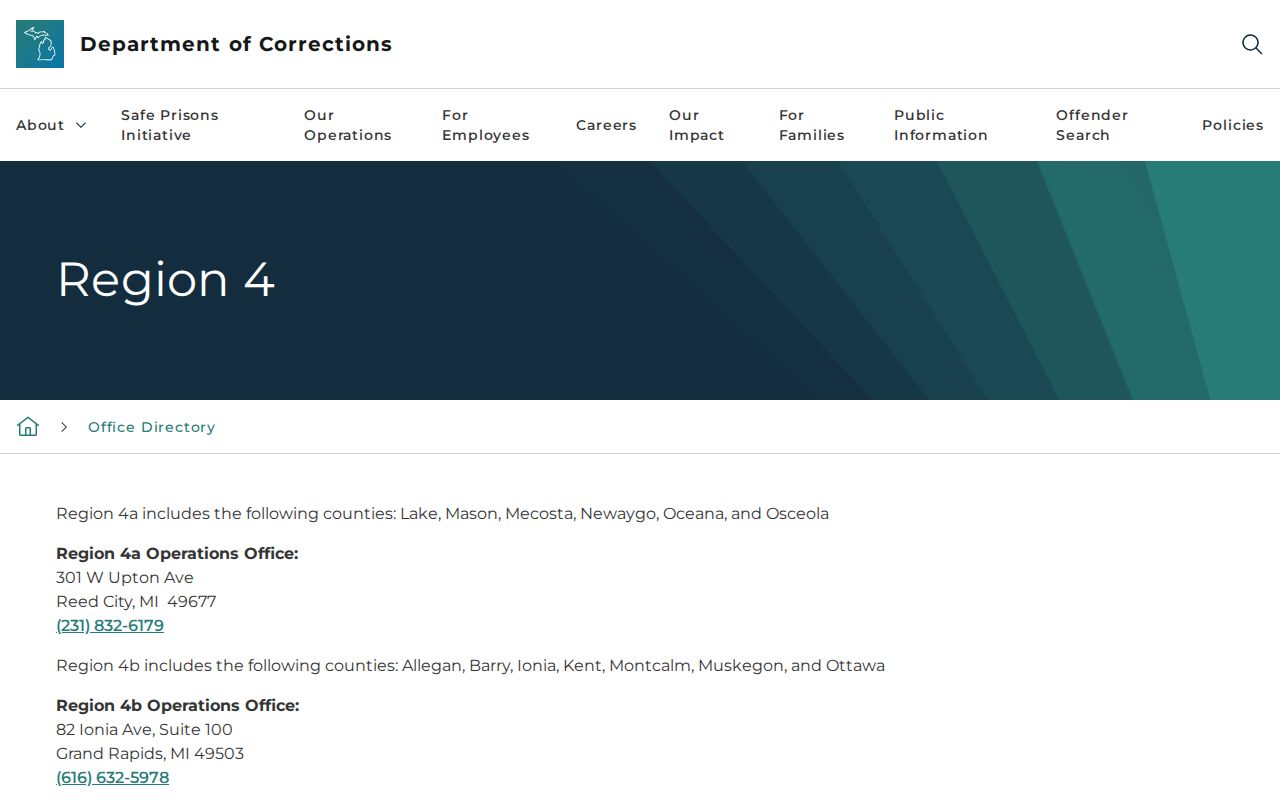
Use the assigned location in the person's OTIS record to choose among the Muskegon County supervision offices.
Muskegon Supervision Absconder Records
An absconder status is not a release date. OTIS defines ABSCOND1 as a parole absconder actively sought by MDOC. ABSCOND2 identifies a probation absconder under the sentencing county's jurisdiction. Neither label gives a safe basis for stating where the person is physically located. The public OTIS Most Wanted screen is also not a complete warrant certificate merely because no person appears on it.
For an apparent mistake, follow the source of the data. Court-derived facts must be corrected through the sentencing court, often by an amended or correcting order. Supervision facts should go to the assigned parole or probation office. The MDOC absconder and escapee tip line is 517-755-0855, as listed with MDOC contacts.
Conditions of supervision are set in the order and individual record. They can regulate reporting, travel, treatment, contact, or other conduct, but conditions must not be guessed from the public status code. A suspected violation can lead to review, a warrant, custody, or another action. Only the responsible agency and court record can establish the actual response.
Note: A field office shown in OTIS identifies administrative supervision, not the current street location of the person.
Muskegon Parole Hearing Records
The Michigan Parole Board is the sole paroling authority for felony prisoners committed to MDOC. Most decisions use a three-member panel. Life-sentence decisions require a majority of the full Board. The ordinary standard in MCL 791.233 still requires reasonable assurance that release will not create the statutory public-safety risk after the minimum date is reached. MCL 791.234 governs parole jurisdiction and special life-sentence rules.
Michigan does not publish one full monthly calendar for every ordinary parole interview. Instead, MDOC posts event-driven lifer-parole and clemency notices through its public hearing registration page. Notices generally appear about two weeks to 30 days before an event and include a registration deadline. Photography, recording, and screenshots of a hearing are prohibited.
The official listing is shown below only as a captured page from the MDOC registration source, not as an image of any proceeding.
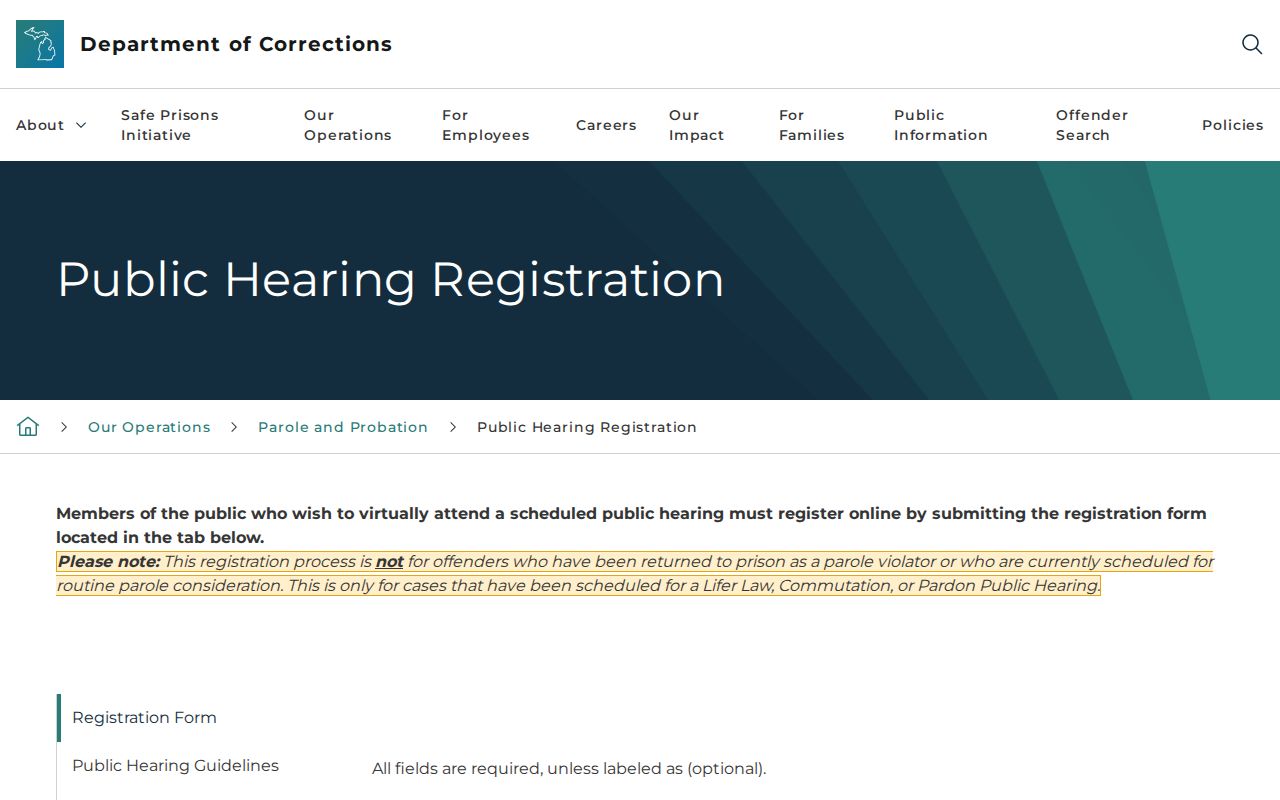
Always return to the current MDOC page because notices and deadlines change by event.
No official person-level database of all parole decisions was found. A prisoner receives a Notice of Decision, while OTIS later shows public status and Date Paroled. Quarterly MDOC reports aggregate granted, denied, and deferred outcomes. A grant may proceed to release processing, be suspended before release, or later be revoked. A denial may lead to later reconsideration. Deferred is not the same as released.
Muskegon Parole Dates Explained
Three OTIS dates must stay separate. Earliest Release Date marks when the Parole Board obtains jurisdiction in the usual indeterminate sentence. It is an eligibility point, not a promise. Date Paroled records when the person left prison or obtained parole status in a nonsecure placement. Discharge Date marks the end of MDOC jurisdiction for that sentence.
A positive parole decision also is not the physical release. MDOC's parole consideration process says the Parole Release Unit handles placement and release steps, and at least 28 days is required between a decision and physical release. New misconduct or other adverse information may suspend a grant. That gap explains why a family may see favorable action but still find the person in prison.
OTIS may keep a discharged person visible for three years after discharge. Once that window closes, seek an available record through MDOC or the sentencing court. Do not treat a vanished public entry as proof that no parole or probation term existed.
Muskegon Prison Reentry Programs
Both active Muskegon MDOC prisons publish prerelease and reentry programming. In April 2025, Earnest C. Brooks Correctional Facility hosted Reentry United, bringing Parole Board members, MDOC education and reentry staff, and community and state partners to people preparing to return. The MDOC Reentry United report provides useful local context.
Program presence does not prove that a named person participated, completed a course, received parole, or has a specific release plan. Those conclusions require the individual's official record. Reentry work helps explain why a release plan may be reviewed during parole processing, but it does not replace the Board decision or the final Date Paroled entry.
Muskegon Release Property Deadlines
A person who “rides out” from the Muskegon County Jail to prison must authorize a designee before departure if someone else will retrieve the property. The Sheriff states that property left behind is held no longer than 15 days after release. This deadline matters when a county custody episode ends in transfer to MDOC rather than a community release.
The Sheriff's inmate property rules separately limit ordinary property release to keys during listed weekday windows and within 72 hours of incarceration. The 72-hour rule is not a release-list window. Property handling also does not prove parole, discharge, or physical freedom. Use the jail transaction to establish transfer, then OTIS for the state-prison and supervision path.
Muskegon Supervision Discharge Records
Supervision ends when the responsible court or MDOC records a lawful discharge, not simply when reporting becomes less frequent or a roster entry disappears. Read the discharge date beside the exact sentence. Multiple cases can overlap, so one completed term does not close another active parole or probation file.
When a formal record is needed, MDOC says an authorized PENPACK may contain certified copies of the Judgment of Sentence, Basic Information Sheet, Parole Eligibility Report, photograph and fingerprints when available, and a Discharge Certificate. Access and redaction depend on law and requester authority. Ask MDOC Records what can be supplied. Michigan FOIA, MCL 15.231 et seq., provides a records-request path, subject to exemptions and lawful fees. A narrow request with a full name, MDOC number, sentence, and date range is easier to process than a demand for every file.