
Muskegon County Release Meanings
A Muskegon County release can mean several different things. Someone may leave the Muskegon County Jail after posting bond, receiving personal recognizance, completing a jail term, obtaining a dismissal, or receiving a court order. The person may also leave the building in a transfer to the Michigan Department of Corrections, another jail, federal custody, or immigration custody. A transfer ends one agency’s custody but does not put the person back in the community.
The custody source controls the next search. The Muskegon County Sheriff records adult county-jail bookings and release transactions. Michigan Department of Corrections records cover state prisoners, parolees, felony probationers, and people discharged within the public OTIS period. The courts record bond, disposition, sentence, and later case events. VINE sends participating-agency custody notices. Each source answers a different part of the same question.
Muskegon County Release Types
The release disposition matters more than a vanished roster row. Muskegon County records may show a true community release, the end of a sentence, or movement into another form of custody. Read the actual label, then test it against the court order, Sheriff transaction, or receiving agency.
| Release type | What it means | Where to check next |
|---|---|---|
| Bond or personal recognizance | The person may leave after all release conditions and holds clear. | Sheriff release transaction, VINE, and the D60 or C14 docket |
| Time served or sentence completion | The ordered county-jail term has been satisfied, subject to other holds. | Judgment of Sentence plus the Sheriff’s completed release record |
| Parole | The person leaves secure state prison but remains under MDOC supervision. | OTIS Date Paroled, status, and assigned field office |
| Discharge | MDOC supervision ends for the displayed sentence. | OTIS discharge information or a releasable MDOC record |
| Transfer | Custody moves to MDOC, another jail, or another authority. | The receiving agency’s system and the Muskegon transfer record |
| Dismissal or court order | The court supplies release authority, but jail processing may follow later. | Court order and the later Sheriff release timestamp |
What does “time served” prove? It proves what the judge ordered on that count. It does not prove the exact time jail staff completed the release, nor does it clear an unrelated hold.
Note: A person on work release remains in jail custody while permitted to leave for approved work periods.
Muskegon County Release Record Fields
A county release record is usually the closing transaction for one booking episode, not a single statewide certificate. A narrow request should identify the person and date range, then ask for the specific fields needed. The Sheriff may redact exempt material, and not every field will exist in one document.
| Field | What it shows |
|---|---|
| Full name and identifiers | Which person the booking episode concerns |
| Booking number | The unique county booking tied to the release |
| Booking date and time | When the jail opened that custody episode |
| Arresting agency | Which agency brought the person into county custody |
| Charges and holds | The listed grounds for detention during that episode |
| Court and case number | The judicial file that may contain bond or sentence authority |
| Release date and time | When the Sheriff recorded the custody exit |
| Disposition or destination | Bond, time served, court order, MDOC transfer, or another result |
Three times may differ. A judge can sign an order first. Jail staff may receive and process it later. Physical departure can occur after that. A MiCOURT docket proves the judicial act, while the Muskegon County release transaction is better proof of the jail event. A VINE alert is useful notice, but it is not a certified record.
Note: Ask for one defined booking episode because the same person may have several unrelated Muskegon County custody records.
Muskegon County Release Bond Checks
Muskegon publishes cash-only, cash-or-surety, and personal-recognizance bond paths. Full cash can be paid through the Hall of Justice account kiosk or online. A surety bond may use a bonding company, while personal recognizance does not require a cash payment. These routes deal with the Muskegon bond, not every possible basis for custody.
The Sheriff’s official bond instructions warn that another jurisdiction’s hold may block release even after the Muskegon bond is satisfied. Keep the payment receipt and check the criminal docket, but seek the Sheriff’s release transaction before stating that the person left custody. If the record says transfer, follow the receiving agency rather than calling it a community release.
Important: Bond payment proves payment. It does not prove that every hold cleared or that the person physically left the jail.
Request Muskegon County Release Records
Sheriff Records is the first official contact for a county booking-and-release transaction. The office is at 990 Terrace Street, first floor, Muskegon, and its telephone number is 231-724-6351. Published counter hours are Monday through Friday, 8:00 a.m. to 4:30 p.m., with a noon to 1:00 p.m. closure. The jail itself runs continuously, but that does not make the records counter a round-the-clock service.
- Collect the full name, date of birth if known, approximate booking dates, and any incident or case number.
- Ask for the booking-and-release record, including booking number, release date and time, disposition or destination, releasing authority, holds, transfers, and any releasable booking photograph.
- Use the Muskegon County online FOIA form or the official paper form. General email is for questions, not request submission.
- Request electronic copies and an itemized fee estimate. The County may charge permitted labor, copying, and mailing costs.
- Compare the response with the court order or VINE event when the exact custody sequence matters.
The County states that it will grant, deny, partially grant, or extend a request within five business days. One extension of up to ten business days is permitted. An electronic request is treated as received on the next business day. A good-faith deposit of up to one-half may be required when an estimate exceeds $50.
Muskegon County Sheriff Records990 Terrace Street, First Floor
Muskegon, MI
231-724-6351
Monday-Friday, 8:00 a.m.-4:30 p.m.; closed noon-1:00 p.m.
Note: Court records come from the clerk, not from the County executive-branch FOIA process.
Muskegon County Release Record Law
Michigan’s Freedom of Information Act, 1976 PA 442 and MCL 15.231 et seq., governs requests to public bodies for existing public records. MCL 15.235 supplies the ordinary response framework. MCL 15.234 governs permitted fees, while MCL 15.243 lists exemptions that can protect privacy and certain law-enforcement interests. A request should describe the booking episode and desired records well enough for staff to locate them.
Public access is not absolute. Juvenile material, sealed records, victim information, medical details, active-investigation material, and other exempt content can be withheld or redacted. Michigan set-aside law can make eligible government conviction and arrest records nonpublic under MCL 780.621 through 780.624. A record that no longer appears online may also have aged out of a portal. Neither result proves that the custody event never happened.
- Release
- The end of one agency’s custody, which may be into the community or into another agency’s custody.
- Parole
- Community placement after prison while MDOC legal custody and supervision continue.
- Discharge
- The end of MDOC jurisdiction for the displayed sentence.
- Detainer
- A request or legal basis for another authority to continue or receive custody.
- Set-aside
- A Michigan process that can make an eligible conviction nonpublic, subject to legal limits and exceptions.
Note: A lawful redaction or set-aside changes public access, but it does not turn an earlier custody event into proof of current status.
Muskegon Release Property Deadlines
Muskegon County’s property rules provide a concrete clue when a person “rides out” to prison or another agency. Only items accepted by the receiving agency go with the person. Before departure, the person must authorize someone to collect property left behind. The jail holds that property no longer than 15 days after release.
The separate 72-hour rule concerns keys, not a released-inmate list. The Sheriff limits ordinary property release to keys during the first 72 hours of incarceration and during published weekday windows. The distinction matters because a property deadline can be mistaken for a custody feed. Use the Sheriff’s inmate-property instructions for the current process.
Property pickup is not proof of freedom. A transfer can leave items behind while the person remains in government custody. Ask the Sheriff for the release or transfer disposition, then check OTIS or the receiving jail if another agency took custody.
Find Muskegon County Released Inmates
Start with the last known custodian. The county portal can answer whether an adult is still listed in Muskegon County Jail. A missing name does not explain the next event. It could reflect release, transfer, a short police hold that never reached county booking, a spelling mismatch, or an update gap.
- Gather the full name, approximate age or birth date, booking or MDOC number, likely custody dates, and court.
- Check the Muskegon County inmate portal for current county custody. Treat a missing result as an open question.
- Search Michigan VINE for a participating-agency release or transfer event and confirm the reporting agency.
- Open both local court systems when needed. D60 handles all adult criminal case starts; felony cases later continue in C14.
- If a prison sentence or MDOC supervision appears, use OTIS and read status, Date Paroled, Earliest Release Date, Maximum Discharge Date, and assigned office.
- For a federal sentence, use BOP. For current immigration detention, use ICE. These systems do not cover a routine county-jail release.
- When the online trail remains unclear, request the Sheriff release transaction, certified court order, or releasable MDOC record.
Important: Released people often leave the live roster. A missing row is a reason to check the next official source, not proof of release.
People seeking a same-day county view should note that Muskegon has no verified rolling public feed. The Muskegon County 24-Hour Release List explains the date-based and records-request fallback without inventing a published list.
Muskegon Released Inmate OTIS Search
The Michigan OTIS overview defines a narrow but important scope. OTIS covers Michigan prisoners, parolees, probationers under MDOC supervision, and people discharged within the preceding three years. It excludes county-jail-only prisoners, unsentenced defendants, city lockup records, and people outside the public retention window. Thus OTIS is the right source after an MDOC commitment, not the proof for a routine Muskegon County Jail release.
| Search field or result | How to use it | Key limit |
|---|---|---|
| MDOC number | Use when known for the most precise initial search. | It applies to MDOC records, not a county booking number. |
| Name | Enter surname and given name, then compare identifiers. | Names collide and spelling varies. |
| Current Status | Read the exact prison, parole, probation, or discharged code. | Status can change after retrieval. |
| Assigned Location | Identify a prison or supervising field office. | A field office is not a home address. |
| Earliest Release Date | Identify when the Parole Board may gain jurisdiction. | It is not a promised release date. |
| Date Paroled | Identify departure from secure prison into parole status. | Parole is not discharge. |
| Maximum Discharge Date | Read the outer sentence date shown by MDOC. | Other sentences or holds may affect actual custody. |
The official OTIS application shows the name and MDOC-number search route.
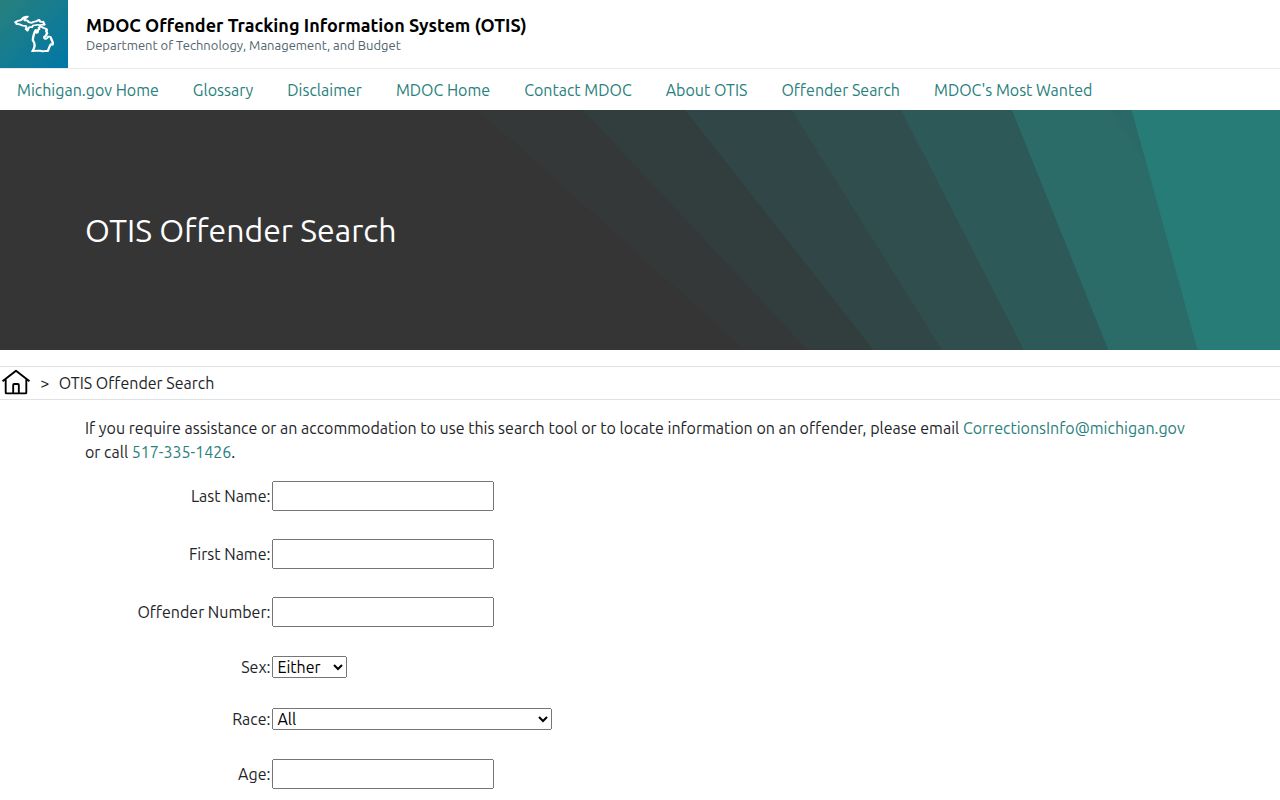
Open the matched record, compare the date of birth, sentencing county, offenses, and photograph, then read every active and discharged sentence block.
Note: OTIS keeps a discharged person public for three years after discharge, not three years after prison departure.
Muskegon Release Court Searches
Muskegon’s court path splits in a way that affects release research. Every adult criminal case starts in the 60th District Court. Misdemeanors remain there. A felony begins in D60, then moves to the 14th Circuit Court after the district court sends it forward for disposition and sentence. Searching only one court can miss the event that explains a bond, dismissal, jail term, probation order, or commitment to MDOC.
Use the exact D60 MiCOURT search and C14 MiCOURT search. Read the register of actions in date order. A docket may show bond posted, dismissal, sentence, jail credit, probation, or an MDOC commitment. It does not capture the precise time the person walked out of the Muskegon County Jail.
Can a court order confirm release? It confirms legal authority. Pair it with the Sheriff transaction when the exact custody exit is the fact at issue. Certified copies come from the responsible clerk, not the County FOIA portal.
Muskegon County Recent Release Search
The Sheriff calls its Zuercher site a county inmate lookup that is available online around the clock. That phrase describes access hours. It does not mean Muskegon publishes a list of people released in the last day or three days. No separately labeled official 24-hour, 48-hour, 72-hour, or recent-release feed was verified.
The dynamic portal includes a Release Date control, but Muskegon does not publish its update cadence or former-row retention. Use the calendar date only for a careful portal check. If it does not return the needed event, check VINE, review the court record, and ask Sheriff Records for all release transactions in the defined period. Do not assume an empty portal result means no one was released.
The Muskegon County inmate portal is the official starting screen for current county custody and its available date controls.
The screen supports a county check, but it should not be described as a guaranteed rolling release archive.
Note: Online access around the clock does not establish that Muskegon County updates each release record in real time.
Muskegon County Release Supervision
Parole, felony probation, district-court probation, and discharge are distinct. A person on parole has left secure prison while MDOC supervision continues. Felony probation generally remains under the sentencing court’s jurisdiction with MDOC field supervision. District-court probation follows a local misdemeanor or jail case. Discharge ends MDOC jurisdiction for the displayed sentence.
Search OTIS and read Current Status plus Assigned Location. Muskegon’s MDOC parole office is at 985 E. Barney Street, while the separate MDOC probation office is at 131 E. Apple Avenue. The 60th District Court probation office is another office at 990 Terrace Street, Suite 100. Match the record and sentencing court before calling. The full distinctions and verification steps appear on the Muskegon County Parole & Probation page.
Muskegon Prison Release Reentry
Muskegon’s two active MDOC prisons publish substantial prerelease and reentry programming. Muskegon Correctional Facility and Earnest C. Brooks Correctional Facility are state prisons, not branches of the county jail. In April 2025, Brooks hosted Reentry United with the Parole Board, MDOC reentry and education staff, and community and state partners for people preparing to return.
This local context does not prove that any named person completed a program or received parole. Verify the individual outcome in OTIS and through MDOC records. A positive Parole Board decision is also not the physical release event because placement and release processing occur later.
Muskegon County Release Notifications
MI-VINE offers public custody and court-status information by VINELink and phone. Choose Michigan, search a specific person, compare identifiers and reporting agency, then read the most recent event. A release event means the participating agency reported a release transaction. A transfer event means custody moved. A no-match result does not prove release.
County registration can report release, transfer, or escape events. State-prison VINE supplies general-release notice, while registered crime victims seeking formal parole-hearing notices use the separate MDOC Crime Victim Notification Unit. Federal BOP and ICE cases use their own systems. The Muskegon County VINE page anchors the statewide service locally.
Note: VINE is an alert service, so formal proof should come from the reporting agency’s record.
Muskegon Federal Release Lookups
No active BOP prison or dedicated ICE detention center was found in Muskegon County. Federal custody can still involve the area through court, transport, or contracted placement. For a sentenced federal person, the BOP Inmate Locator can show a federal release date and a Released or Not in BOP Custody result. That status ends BOP custody only. It does not rule out state, local, immigration, or supervised-release status.
ICE’s Online Detainee Locator checks current covered immigration custody, not a historical release archive. The U.S. Marshals Service handles federal pretrial custody and transport but has no public historical release locator like BOP. If a Muskegon roster name vanishes in a federal matter, use the federal docket, Marshals district, and known holding facility rather than treating the absence as release.
Muskegon Release Source Comparison
The right source depends on the custody path. A current-custody tool can show who remains listed, while a closed record or discharge source is needed after a person leaves that system.
| Situation | Best starting source | What still needs care |
|---|---|---|
| Still in Muskegon County Jail | County inmate portal | Portal timing and other-jurisdiction holds |
| Released from county jail | Sheriff release transaction and VINE | Court order time may differ from physical exit |
| Transferred to state prison | OTIS after MDOC intake | The transfer is not a community release |
| Paroled or discharged by MDOC | OTIS and MDOC records | Parole continues supervision; discharge ends it |
| Federal sentence | BOP Inmate Locator | Not in BOP custody does not clear every system |
| Immigration custody | ICE locator for current covered detention | No-match is not a historical release record |
| Police hold without jail booking | Arresting department and D60 court | The county roster may never contain a row |
Muskegon Release Facility Geography
Muskegon County has an unusually dense corrections landscape. The modern Muskegon County Jail sits in the county court complex. Two active MDOC prisons operate close together on Sheridan Drive. West Shoreline Correctional Facility, another MDOC name that can appear in older files, closed in 2018. “Held in Muskegon” therefore does not identify the custodian.
A county-jail release belongs in Sheriff records. A release or parole from Muskegon Correctional Facility or Earnest C. Brooks Correctional Facility belongs in OTIS and MDOC records. Historical West Shoreline files also follow the MDOC route. A youth at the Juvenile Detention Center is governed by the Family Division, and juvenile information may be confidential or nonpublic.
- Muskegon County Jail: county adult custody, community release, or transfer record through the Sheriff.
- Muskegon County Juvenile Detention Center: court-authorized youth release through the Family Division.
- Muskegon Correctional Facility: active MDOC prison with parole or discharge tracked through OTIS.
- Earnest C. Brooks Correctional Facility: active MDOC prison with state release and transfer records.
- West Shoreline Correctional Facility: closed MDOC facility relevant to older records only.
Muskegon Post-Release Financial Records
Leaving custody does not erase Muskegon court costs, fines, restitution, jail room-and-board, or other valid balances. County Collection Services identifies payment channels and states that a one-time 20 percent late fee may be added after 56 days without payment. Those account facts do not show whether a person is still jailed.
Work release has a separate fee structure because the person remains in custody while leaving for approved work. Published weekly advance charges range from $100 for up to 40 work hours to $200 for more than 70 and up to 80 hours. Felony work release requires a tether with a published provider charge of $192.50. Confirm current amounts before payment. A work-release balance is not a release date or proof of present custody.
Keep financial records separate from custody proof. Use the Sheriff transaction for the county release event, OTIS for state parole or discharge, and the court docket for the underlying order.