
Brooks Release Outcomes
Earnest C. Brooks Correctional Facility, commonly identified by the MDOC code LRF, holds adult men at Levels I, II, and IV. It is part of the Michigan Department of Corrections. It is not an annex of the Muskegon County Jail. That line controls which record to use. The Sheriff’s portal can answer a county-jail custody question, but it does not track a person serving a state prison sentence at Brooks. State custody follows the person through the MDOC system.
Leaving the Brooks grounds can take several forms. Parole places the person in the community while MDOC supervision continues. A discharge ends MDOC authority for the displayed sentence. A transfer moves the person to another MDOC institution and is not a community release. A nonsecure placement can also change the assigned setting without ending state control. The facility name by itself proves none of these results. Read the current status and every sentence entry before deciding what happened.
| Brooks outcome | What it means | Best public check |
|---|---|---|
| Parole | Secure prison ends, but MDOC supervision continues | OTIS status, Date Paroled, and assigned office |
| Discharge | MDOC control ends for the identified sentence | OTIS discharge date or an MDOC record |
| Prison transfer | The person stays in state custody at another site | OTIS current status and assigned facility |
| Older record | The public display may have reached its time limit | MDOC records and the sentencing court |
Confirm Brooks Release Status
Begin with the Michigan OTIS search. OTIS means Offender Tracking Information System. An MDOC number is the strongest search key because people can share names. If that number is not known, search by surname and given name. Then match the date of birth, sentencing county, offense details, and photograph when one is available. Open the full result. A name on the result screen is only the first match step.
OTIS covers current Michigan prisoners, parolees, probationers under MDOC supervision, and people discharged during the prior three years. It does not cover a jail-only term or an unsentenced county detainee. That scope makes OTIS right for Brooks, but not for every person arrested in Muskegon County. The Muskegon County released-inmate search paths help sort out the responsible custodian when an old note only says the person was held “in Muskegon.”
- Search by MDOC number when it is known.
- Match the person with birth, offense, county, and photo details.
- Open the record and read each active and discharged sentence.
- Compare Current Status, Assigned Location, Date Paroled, and discharge fields.
- Record the search date because the public status can change.
- Ask MDOC Records for the exact document when the result is missing or unclear.
Read Brooks Release Fields
Michigan does not display one assured projected release date. OTIS uses several fields that answer separate questions. Earliest Release Date is based on the Judgment of Sentence and marks the point when the Parole Board gains jurisdiction in the usual indeterminate sentence. It does not promise parole on that day. Maximum Discharge Date is the possible sentence end if no other sentence or hold supports continued custody. Date Paroled records a parole event, not the end of state supervision.
Read all sentence blocks. One count may be discharged while another remains active. Consecutive terms, amended court orders, placement review, misconduct, a detainer, or another sentence may also affect what happens next. A detainer is a request or legal basis for another authority to take or keep custody. When the public dates and status seem to conflict, preserve the result and ask the right source. Court-derived mistakes go to the sentencing court. Supervision facts go to the assigned parole or probation office.
| OTIS field | How to read it |
|---|---|
| Current Status | Shows prison, parole, probation, discharge, or another listed MDOC state |
| Assigned Location | Identifies a prison or field office, not a home address |
| Earliest Release Date | Marks parole jurisdiction, not guaranteed physical release |
| Maximum Discharge Date | Shows a potential sentence end, subject to other lawful custody |
| Date Paroled | Identifies the move from secure prison into parole status |
| Discharge Date | Shows the end of MDOC control for the linked sentence |
Note: “Paroled” and “discharged” are not synonyms; the first keeps MDOC supervision in place while the second ends it for that sentence.
Brooks Records and Contacts
The official Brooks facility profile lists the prison at 2500 S. Sheridan Drive in Muskegon Heights and gives the main phone as 231-773-9200. The facility can route a current institution question. A formal parole, discharge, transfer, or older offender-history request belongs with MDOC. The Muskegon County Sheriff does not create Brooks release records, so a county records request is the wrong route for this state prison.
Earnest C. Brooks Correctional Facility2500 S. Sheridan Drive
Muskegon Heights, MI 49444
231-773-9200
Michigan Department of Corrections
MDOC lists its records and FOIA routes on the department contact page. General questions may go to 517-335-1426 or CorrectionsInfo@michigan.gov. The department’s FOIA office is reached at 517-335-4194 or MDOC-FOIA@michigan.gov. Keep a request narrow. Give the full name, MDOC number, date range, Brooks as the known facility, and the exact record sought, such as a transfer entry, parole document, discharge certificate, or permissible institutional record.
The MDOC contact directory is also a useful source when a public search does not settle the matter.
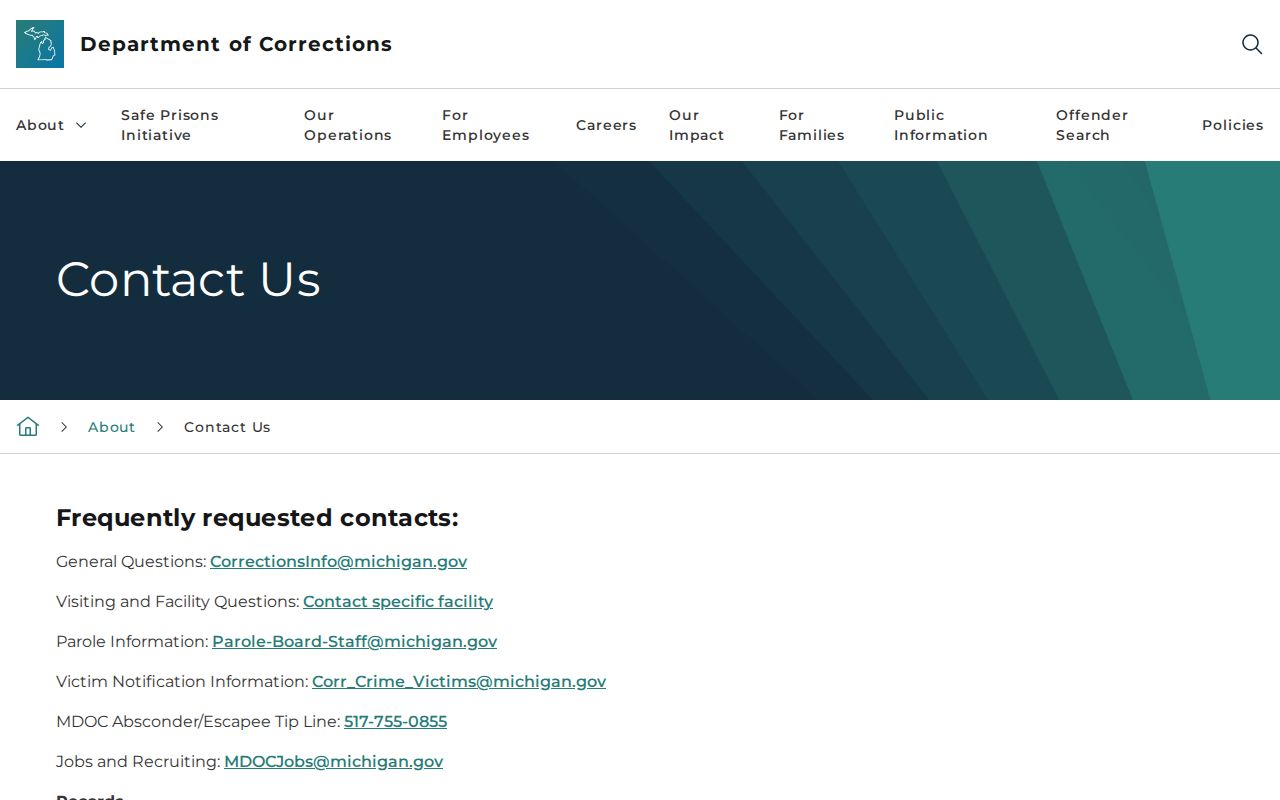
The captured contact page confirms that state offices, not county jail staff, handle records tied to an MDOC prison sentence.
Inside Earnest C. Brooks
Brooks is an active men’s institution with six prison units. Those units span three published security levels and include segregation. Level I, II, and IV designations describe different custody controls within the same MDOC site. They do not forecast a release date. A change in unit or security level may be an internal placement decision, while the public release fields still depend on the sentence, parole process, and other legal authority.
The prison also publishes education, treatment, and reentry-related programming. Such programs can support preparation for return, but a program listing is not person-level evidence. It does not prove enrollment, completion, parole approval, or physical release. The status still comes from OTIS and, when needed, the underlying MDOC record.
The official Brooks profile provides the most direct view of the active prison and the programs MDOC lists there.
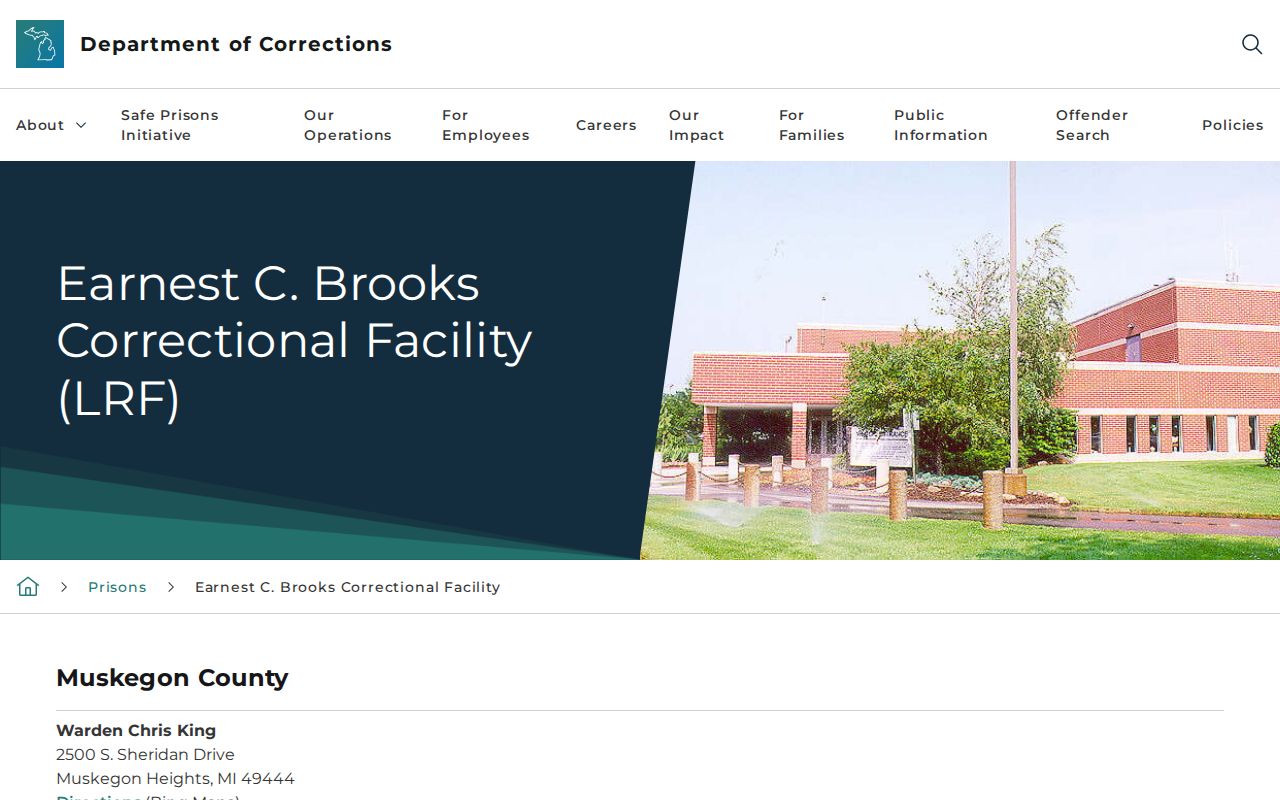
The profile establishes the facility and operator. A named person’s parole, discharge, or transfer still requires the individual OTIS record or an MDOC records response.
Brooks Release Planning
A favorable parole decision and physical departure are separate events. The Michigan Parole Board decides parole for felony prisoners committed to MDOC, but release processing comes afterward. Placement must be arranged and reviewed. New misconduct or other adverse facts may pause a grant before the person leaves. For that reason, an earliest date or a Board action should not be reported as the day someone walked out of Brooks.
Once a person is paroled, the assigned location in OTIS may be a parole field office. It is not the person’s residence. Supervision can take place in Muskegon County or elsewhere, depending on the approved plan and assignment. Full discharge is different. It ends MDOC control for the displayed sentence, though an unrelated case or other lawful custody may still exist. A precise check records both the person’s physical move from prison and the later point, if any, when state supervision ends.
- Parole
- Release from secure prison with MDOC supervision still active.
- Discharge
- End of MDOC authority for the identified sentence.
- Transfer
- Movement to another institution while state custody continues.
- Detainer
- Authority that may cause transfer or continued custody elsewhere.
Muskegon Correctional Crossroads
Muskegon’s correctional geography can make an old custody note hard to read. A large county jail opened in 2015, while two active MDOC prisons sit on Sheridan Drive. Brooks is at 2500 S. Sheridan Drive in Muskegon Heights. Muskegon Correctional Facility is nearby at 2400 S. Sheridan Drive. West Shoreline Correctional Facility also shared the Brooks address and services before it closed in 2018. These are distinct records paths despite their close location.
Choose the source by the operator and time period. A Sheriff booking belongs to the county portal and Sheriff records. Brooks and Muskegon Correctional Facility release records belong to OTIS and MDOC. West Shoreline is a historical facility, so a former prisoner may require an older MDOC request or sentencing-court file when the public OTIS period has passed. The phrase “released in Muskegon” is too broad until the last custodian is known.
View Brooks Release Sources
The public route has a clear order. First, establish that Brooks was the relevant institution. Next, match the person in OTIS and read each sentence. Then compare status, location, parole, and discharge fields. If the person is beyond the three-year post-discharge public window, or if a set-aside or exempt record affects display, ask MDOC for the permissible older material. A missing public result should be described as a limit, not proof that no state record exists.
Formal proof may require more than a screen result. An MDOC discharge certificate is strong evidence that the identified sentence and supervision ended. A parole order supports the legal basis for supervised release. A transfer record shows that custody continued at another site. A sentencing-court order can resolve court-derived facts, but it does not by itself give the exact time of physical departure from Brooks. Matching the document to the question prevents a parole date, discharge date, and transfer date from being treated as one event.
Note: OTIS may keep a discharged record public for three years, so an older no-match should lead to MDOC Records rather than guesswork.